Showing posts with label cynicism. Show all posts

Wednesday, October 15, 2014

THE STATESMAN WHO HAS NO OTHER OBJECT THAN TO MAKE YOU VOTE FOR HIS PARTY

A couple of days ago, Lizzie Dunford, assistant house steward at Shaw's Corner and avid blogger, posted an interesting quotation by Shaw on her Facebook timeline: 


"The statesman who has no other object than to make you vote for his party at the next election may be starting you on an incline at the foot of which lies war, or revolution, or a smallpox epidemic, or five years off your lifetime." 
The quotation, as Lizzie rightly notes, belongs to a 1911 piece. Specifically, to the Preface to Three Plays by Brieux, a book containing the English translation of three works by French playwright Eugène Brieux. The book was published by Brentano and contained two different versions of Maternity - one of them translated by Charlotte Shaw, and the other by John Pollock. Together with the two versions of Maternity, the volume also included The Three Daughters of M. Dupont (trans. by St. John Hankin) and Damaged Goods (trans. by John Pollock). 

What seems odd about this quotation - at least when taken out of context - is that one may get the impression that Shaw is yet again grinding the axe of Fabian socialism and political reformation. Although that is partially the case, for Shaw never wrote a single line "for art's sake," the expanded context clarifies that Shaw is, by and large, trying to illustrate how the true dramatist, the man of genius, has a moral obligation to "interpret life." In other words, those who have got it must exert their "power of accurate observation" in order to educate, rather than "amuse themselves or their audiences." 

I reproduce the whole paragraph below for the amusement (and enlightenment) of my readers, in an attempt to "pick out the significant incidents from the chaos of daily happenings, and arrange them so that their relation to one another becomes significant." 

"But the great dramatist has something better to do than to amuse either himself or his audience. He has to interpret life. This sounds a mere pious phrase of literary criticism; but a moment's consideration will discover its meaning and its exactitude. Life as it appears to us in our daily experience is an unintelligible chaos of happenings. You pass Othello in the bazaar in Aleppo, lago on the jetty in Cyprus, and Desdemona in the nave of St. Mark's in Venice without the slightest clue to their relations to one another. The man you see stepping into a chemist's shop to buy the means of committing murder or suicide, may, for all you know, want nothing but a liver pill or a toothbrush. The statesman who has no other object than to make you vote for his party at the next election, may be starting you on an incline at the foot of which lies war, or revolution, or a smallpox epidemic, or five years off your lifetime. The horrible murder of a whole family by the father who finishes by killing himself, or the driving of a young girl on to the streets, may be the result of your discharging an employee in a fit of temper a month before. To attempt to understand life from merely looking on at it as it happens in the streets is as hopeless as trying to understand public questions by studying snapshots of public demonstrations. If we possessed a series of cinematographs of all the executions during the Reign of Terror, they might be exhibited a thousand times without enlightening the audiences in the least as to the meaning of the Revolution: Robespierre would perish as "un monsieur" and Marie Antoinette as "une femme." Life as it occurs is senseless: a policeman may watch it and work in it for thirty years in the streets and courts of Paris without learning as much of it or from it as a child or a nun may learn from a single play by Brieux. For it is the business of Brieux to pick out the significant incidents from the chaos of daily happenings, and arrange them so that their relation to one another becomes significant, thus changing us from bewildered spectators of a monstrous confusion to men intelligently conscious of the world and its destinies. This is the highest function that man can perform — the greatest work he can set his hand to; and this is why the great dramatists of the world, from Euripides and Aristophanes to Shakespear and Moliere, and from them to Ibsen and Brieux, take that majestic and pontifical rank which seems so strangely above all the reasonable pretensions of mere strolling actors and theatrical authors."


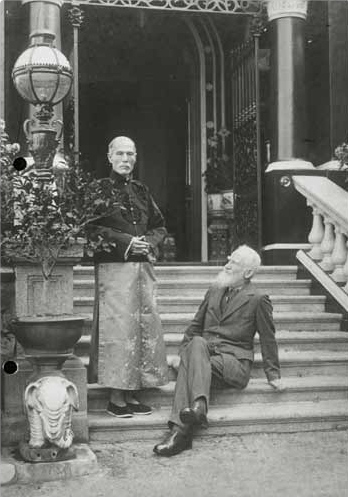
Hotung and GBS 1933


Saturday, August 23, 2014

THE POWER OF ACCURATE OBSERVATION... CONTINUED

After my previous post, Richard Dietrich emailed me (yet again!) saying that he "would have bet his last dollar" (sic.) that that quotation was to be found in The Quintessence of Ibsenism.

While all ISS members are keeping their fingers crossed that Dick's gambling problem is just a question of understanding figurative language - given that he is also de treasurer of the ISS - it is also true that he is not entirely wrong. 

Indeed, there are a couple of passages in The Quintessence that stress how often people mistake blunt sincerity for cynicism. Actually, the question is that the exceptional person will be the one who can see the truth in everything - no matter how unpleasant it is. Thus, the following paragraph sums up the idea that 

"We then have our society classified as 700 Philistines and 299 idealists, leaving one man unclassified. He is the man who is strong enough to face the truth that the idealists are shirking. He says flatly of marriage, "This thing is a failure for many of us. It is insufferable that two human beings, having entered into relations which only warm affection can render tolerable, should be forced to maintain them after such affections have ceased to exist, or in spite of the fact that they have never arisen. The alleged natural attractions and repulsions upon which the family ideal is based do not exist; and it is historically false that the family was founded for the purpose of satisfying them. Let us provide otherwise for the social ends which the family subserves, and then abolish its compulsory character altogether." What will be the attitude of the rest to this outspoken man? The Philistines will simply think him mad. But the idealists will be terrified beyond measure at the proclamation of their hidden thought — at the presence of the traitor among the conspirators of silence — at the rending of the beautiful veil they and their poets have woven to hide the unbearable face of the truth. They will crucify him, burn him, violate their own ideals of family affection by taking his children away from him, ostracize him, brand him as immoral, profligate, filthy, and appeal against him to the despised Philistines, specially idealized for the occasion as SOCIETY. How far they will proceed against him depends on how far his courage exceeds theirs. At his worst, they call him cynic and paradoxer: at his best they do their utmost to ruin him if not to take his life. Thus, purblindly courageous moralists like Mandeville and Larochefoucauld, who merely state unpleasant facts without denying the validity of current ideals, and who indeed depend on those ideals to make their statements piquant, get off with nothing worse than this name of cynic, the free use of which is a familiar mark of the zealous idealist. But take the case of the man who has already served us as an example — Shelley. The idealists did not call Shelley a cynic: they called him a fiend until they invented a new illusion to enable them to enjoy the beauty of his lyrics — said illusion being nothing less than the pretence that since he was at bottom an idealist himself, his ideals must be identical with those of Tennyson and Longfellow, neither of whom ever wrote a line in which some highly respectable ideal was not implicit."

George Bernard Shaw by Edmund S. Valtman ppmsc.07950

When I read this passage, there was another one that inmediately came to my mind because of its identical theme and its strikingly metaphorical mode of expression. Specifically, I recalled the anecdote Shaw recounts about when he had an argument with an artist who 

"…lectured me for not consulting my eyes instead of my knowledge of facts. "You don't see the divisions in a set of teeth when you look at a person's mouth," he said: "all you see is a strip of white, or yellow, or pearl, as the case may be. But because you know, as a matter of anatomic fact, that there are divisions there, you want to have them represented by strokes in a drawing. That is just like you art critics &c, &c. "I do not think he believed me when I told him that when I looked at a row of teeth, I saw, not only the divisions between them, but their exact shape, both in contour and in modelling, just as well as I saw their general color."

This story is quoted in several secondary sources, but I believe Shaw included it in print for the first time in The Sanity of Art. 

At any rate, whether in the plastic arts, in drama, or in sociology, I guess many of my readers agree that Shaw had an exceptional eyesight - sometimes even foresight and second sight, if you ask me. 

Thursday, August 21, 2014

THE POWER OF ACCURATE OBSERVATION IS COMMONLY CALLED CYNICISM BY THOSE WHO HAVE NOT GOT IT

A recent facebook update by ShawChicago reminded me of one of my favourite Shaw quotations of all time. 

"The power of accurate observation is commonly called cynicism by those who have not got it."

Be it because I'm a bit of a cynic myself, or because a great deal of what I like about Shaw has to do with what others call "his cynical way of looking at things," the fact is that I've always liked to drop this line here and there. 
Ulica Bernarda Shawa, Dubrovnik
Bernard Shaw Street. Dubrovnik, Croatia. 
However, until today, I had never bothered to look it up and find out a little more about when and where it was written. I must confess I was very surprised. 

This quotation - slightly altered in its original syntax - was first published as part of one of Shaw's pieces of music criticism. Specifically, in an article dated 18 July 1894 about "the production of Der Freischütz and Fidelio at die German Opera," which was included in the third volume of his Music in London (1890-1894).


As you can see from the expanded quotation in context, Shaw was criticizing the ostentation and "tackiness" of certain outdated props:


"To appeal to our extinct sense of the supernatural by means that outrage our heightened sense of the natural is to court ridi­cule. Pasteboard pies and paper flowers are being banished from the stage by the growth of that power of accurate observation which is commonly called cynicism by those who have not got it; and impossible bats and owls must be banished with them. Der Freischütz may be depended on to suggest plenty of phan­tasmagoria without help from out-of-date stage-machinists and property-masters."


Frankly, I am sometimes amazed by how Shaw's ideas and interestes changed or evolved throughout his life, but that uncanny knack for writing wittily and precisely was always with him. Perhaps it has to do with his self-imposed training when he still thought he would become a novelist. 


Celebrities in Soong Ching-ling's home
Celebrities (including Shaw, unmistakeable) at Soong Ching-ling's home.
As was to be expected, this quotation has made its way into countless books and articles worldwide. For example, in The Cambridge Guide to Theatre (p. 1022) as a means to introduce the topic of food on stage, since "pasteboard pies" were no longer in vogue, according to Shaw. 

Well, one more Shaw quotation sourced, a million more to go. Wait, am I being cynical?