Wednesday, February 17, 2016

A REVOLUTION ALWAYS SEEMS HOPELESS AND IMPOSSIBLE THE DAY BEFORE IT BREAKS OUT

A few days ago I discovered that the terrorist who was responsible for the 2011 Norway attacks had written a manifesto in which he quotes Shaw twice. The first quotation is one of the aphorisms in "Maxims for Revolutionists," one of the addenda to Man and Superman, and it reads: 

"Liberty means responsibility. That is why most men dread it."

Reign of the Superman

The other quotation is a little bit more complex. Not only because the whole sentence has the usual convolute syntax that so many of us have grown to enjoy, but because it is part of a longer context that needs to be discussed as well. The quotation in question is the following: 

"A revolution always seems hopeless and impossible the day before it breaks out and indeed never does break out until it seems hopeless and impossible."

As many of you may remember, this fragment is from the Preface to Back to Methuselah. Specifically, it is part of the section called "The Betrayal of Western Civilization." In this section, before writing the sentence I have quoted above, Shaw is complaining about the abuses on the part of allegedly democratic governments in the form of censorship and repression (though not exclusively) because they are afraid.

"Statesmen are afraid of the suburbs, of the newspapers, of the profiteers, of the diplomatists, of the militarists, of the country houses, of the trade unions, of everything ephemeral on earth except the revolutions they are provoking; and they would be afraid of these if they were not too breaks out, and indeed never does break out until it seems hopeless and ignorant of society and history to appreciate the risk, and to know that a revolution always seems hopeless and impossible the day before it impossible; for rulers who think it possible take care to insure the risk by ruling reasonably."

In other words, what may seem like encouragement for revolutionists is actually a plea for reasonable government. This surprises no-one among Shavians, for we know Shaw was not a man of action. 

That is perhaps why Lenin called him "a good man fallen among Fabians."

That is perhaps why he decided to walk away from the Bloody Sunday riots.

That is perhaps why he joined and promoted a political (Fabian) society that was named after a Roman general that defeated Hannibal with delaying tactics.  

And that is perhaps why we find interesting connections between censorship and revolution in Shaw's writings. So, for example, we can read something to the same effect of the above in the Statement of the evidence in chief of George Bernard Shaw before the Joint-Committee on Stage Plays (1909).

"The Inquisition and the Star Chamber, which were nothing but censorships, made ruthless war on impiety and immorality. The result was once familiar to English­men, though of late years it seems to have been for­gotten. It cost England a revolution to get rid of the Star Chamber. Spain did not get rid of the Inquisition, and paid for that omission by becoming a barely third-rate power politically, and intellectually no power at all, in the Europe she had once domin­ated as the mightiest of the Christian empires."
Paradoxically (not quite), as he points out in his famous letter to H. M. Hyndman (28 April 1900), Shaw is a revolutionary himself, but a "moral revolutionary"

"I am a moral revolutionary, interested, not in the class war, but in the struggle between human vitality and the artificial system of morality, and distinguishing, not between capitalist & proletarian, but between moralist and natural historian." 

Shavians of the world, unite! 
G Bernard Shaw 2

Tuesday, January 26, 2016

BERNARD SHAW AND REPARTEE: UNDESERVING SUCH PRAISE.

A few weeks ago, my faithful Google Alerts brought to my email inbox an article in The New Indian Express that illustrates the concept of repartee by providing a number of examples. Notably, two of them have Bernard Shaw as one of the necessary protagonists. The first of them has already been discussed here, and has been discarded as completely apocryphal. The other one, however, I had never heard of. It goes like this: 

"Cornelia Otis Skinner won critical acclaim in the lead role of Shaw’s play Candida. Shaw cabled, “Excellent. Greatest.” Skinner, overjoyed, replied, “Undeserving such praise.” Shaw cabled back, “I meant the play.” Pat came the reply, “So did I.”"

If you Google the key words in this exchange, you will quickly realize that the anecdote has been quoted countless times, even if we only list articles that are available online, like this one, this one, or this one. However, no source is provided in any of the instances I've come across. Not even in books that claim to have researched the question, or in the secondary sources they cite.  

Of course, the first thing I did was to check my database and, there it was! There is at least one book that makes reference to this witty repartee. Although, as we shall see, it is not the most reliable of sources. The exact details follow. 

On page 249 of Allan Chappelow's Shaw the Villager and Human Being, we read how Dr. William Maxwell recounts a story that Shaw told him when he was staying with him in Edimburgh: 

"The scene was the 90's, when he was a music critic. He had been invited to a soirée in the house of a noted society lady. She had engaged a violinist (in whose career she had taken an interest) to entertain her guests—there were hundreds of them—and at the end of the evening, asked Shaw what he thought of her protégé. He replied that the violinist reminded him of Paderewski. 'But Paderewski is not a violinist,' she said. ' Exactly,' replied G.B.S. !"

This paragraph ends with a footnote where the author goes on to say that "this amusing story prompted me to tell Dr. Maxwell the following one of a similar flavour." Of course, "the following one" is the story we have quoted at the beginning of this post.


Admittedly, Chappelow does not provide any other source but his own knowledge, and we cannot take his words as confirmation that the exchange between Shaw and Skinner ever took place. As we all know, Chappelow made Shaw's aquaintance when he visited him in 1950 (the year of Shaw's death) and took the last known photographs of him. Therefore, he can only have learned about this anecdote from secondary sources, and it is unlikely that Shaw should have ever mentioned this to him in person - Chappelow would  have probably included that information in his book.

In all, it seems that this quotation may well be apocryphal or, ultimately, impossible to confirm. There is nonetheless evidence to give credibility to this repartee. In 1943 (during Shaw's and Skinner's own lifetimes) Isabella Taves published a book entitled Successful Women and How They Attained Success. The chapter devoted to Cornelia Otis Skinner (pp. 69-78) also contains the same story, practically in the same words. 

Although I know of no data to confirm this, it is plausible to believe that either Shaw or Skinner (or both) might have come across this book - if the author did not send a complimentary copy herself. Wouldn't they have corrected Taves if the story weren't true? Who knows?


Cornelia Otis Skinner

Tuesday, January 19, 2016

POLITICS AND THE UNCOMMON MAN

I came across a somewhat lengthy quotation - allegedly by Shaw - the other day, as I was perusing an article about Greenwood Village's local election. Don't ask me why. 

The quotation reads as follows: 

“It is a curious fact that when we get sick, we want an uncommon doctor. If we have a construction job, we want an uncommon engineer. When we get into war, we want and uncommon admiral and an uncommon general. Only when we get into politics are we content with the common man.”

As usual, no source is provided. So I seached my database and... nothing! 

Well, it's no wonder. It turns out that none other than 
President Herbert Hoover pronounced these words as part of a telephone address from New York City to Wilmington College, Wilmington, Ohio on the occasion of the conference "Building For A Better Tomorrow." If you read the links below you'll see just how fitting the title was.  

The full text of the speech can be read at 
the Hoover Association's page, and you can see that it was later published as a booklet - a copy of which is available at the National Archives's site


HerbertClarkHoover


Well, another misattribution, another dollar. We know of many witticisms and other quotations that have been erroneously ascribed to Shaw. 

However, this blog has no interest in the words of American Presidents - 
except for the occasional Shavianism. In fact, political speeches - or, rather, the speeches of politicians - are practically anathema for Shaw. See, for instance, what he had to say about the way the politicians of his time delivered their speeches through the wireless: 

"Most of the politicians are awful. Lloyd George was bad enough, and Churchill is no better. Someone ought to tell them that their House of Commons style, with long pauses between every word to think out what they are going to say next, is pitiful through the mike, especially when they pronounce their prepositions and conjunctions as if they were speaking oracles."

The quotation is from 
Hesketh Pearson's Bernard Shaw: A Biography (p. 469), and many of my dear friends from the ISS should re-read at least that page because another thing Shaw is quoted as saying is "Do you know anything about these infernal Shaw Societies?"  

At any rate, since Shaw was actually referring to style rather than to content, I'll spare President Hoover, Winston Churcill and all other politicians, and publish the post all the same. 


Saturday, December 19, 2015

A FUNNY FREUDIAN? SLIP

Because this is not really a quotation, I am going to be brief. 

The other day I was searching for the latest publications on Bernard Shaw - I use Google Books and Google Scholar for that, among other repositories - when the title of one of the books that made reference to Shaw caught my eye. It was Ancient Rome and the Construction of Modern Homosexual Identities

It took me a while to find the two references to "Bernard Shaw" in the book, and it took me a while more to understand what was going on. 

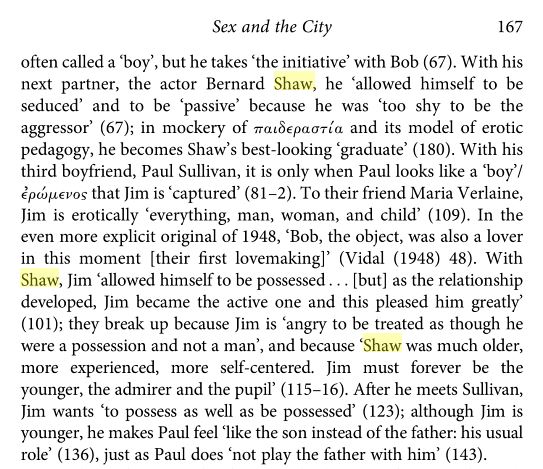
It turns out that in Chapter 8 ("Petronius' Satyrica and Gore Vidal's The City and the Pillar"), the author (Nikolai Endres) discusses the depiction of homosexual relationships between a young boy and an older man. When he describes the case of Jim in The City and the Pillar, he mistakes the name of the actor he has an affair with in the novel (Ronald Shaw) for that of Bernard Shaw. Thus, a rather unexpected paragraph follows, reproduced here: 


Although it is simply a small typographical error that does not subtract from the quality of the chapter, let this be a warning to all my readers about the perils of the internet. And also a token of the type of chaff that the editor of the Continuing Checklist of Shaviana has to separate from the wheat. 

Tuesday, December 15, 2015

SKELLIG MICHAEL: "PART OF OUR DREAM WORLD"

A few days ago, ISS President Michael O'Hara brought to my attention an article in The New York Times with an unlikely connection between Star Wars and Shaw

The article in question describes the natural beauty of one of Ireland's "most mystical places," Skellig Michael (Sceilg Mhichíl). The article also describes a recent visit to the site by Star Wars actor Mark Hamill, who played Luke Skywalker in the original trilogy. Both Hamill and the author (Lucinda Hahn) seem to have fallen in love with the place and, to add another preacher to the choir, Hahn quotes Shaw's description of Skellig Michael: 

No wonder George Bernard Shaw, following a visit in 1910, described Skellig Michael this way: “I hardly feel real again … I tell you, the thing does not belong to any world that you and I have lived and worked in: It is part of our dream world.”


Of course, nobody ever thinks of poor people who cannot sleep a wink if they cannot source their Shaw quotations - and alas, no source is provided. Luckily for me, it didn't take long to find the source.  

The fragments Hahn quotes belong to a letter Shaw sent to Frederick Jackson (18th Sept., 1910). The letter has been published in Dan H. Laurence's edited collection of Shaw's correspondence (Collected Letters, 1898-1910, p. 941-943). 

However, the article in the NY Times fails to mention that the two excerpts they quote appear in reverse order in Shaw's letter, and that they are also separated by quite a few lines. 

For those of you who may not have a copy of Laurence's Collected Letters at hand, I am glad to inform you that Kay Li (the leader of the Shaw-Sagittarius project, one of the Sagittarius Literature Digitizing Projects) has shared with us an online version of the letter, which you can read in its entirety. The text is an exact copy of the original letter as published. 

Apart from the beauty of the place, the words "dream world" have certainly drawn the attention of many Shaw critics who have chosen this letter to illustrate their appraisal of, for example, Shaw's views about Ireland. Let us look at some of them, in no particular order. 

Sally Peters, in her Bernard Shaw: The Ascent of the Superman (p. 27-28), reminds us that Shaw was visiting his homeland and felt "besieged by a strong sense of his own mortality." Peters also finds reminiscences of "the hold of this fantastic rock on Shaw's imagination" in the "strange outcroppings that surface in the settings for Too True to Be Good (1931) and The Simpleton of the Unexpected Isles (1934)."

Michael Holroyd's Bernard Shaw: The One-Volume Definitive Edition also delves on the emotional dimension of this excursion, which probably brought back fond memories of childhood days for Shaw. In Holroyd's words (p. 364)

"Upon this cathedral of the sea, the man who generally seemed a stranger on the planet felt at home. Standing in the graveyards at the Skellig summit, he recalled the summers of his early years when Sonny roamed over the rocks and goat-paths of Dalkey, and gazed across the blue waters to Howth Head; or had lain on the grassy top of the hill above the bay - then raced down to the shore known as White Rock and plunged into the waves. Sonny had been a product of Dalkey’s outlook: there was little place for him in the bustling world where G.B.S. moved. But he breathed again in the magic climate of this island." 

A. M. Gibbs's A Bernard Shaw Chronology does not provide us with any critical commentary, but reminds us that the famous rowboat trip was only a consequence of having "failed to reach them [the Skelligs] by yatch on the 16th." In addition, in Bernard Shaw: A Life (by the same author) reference is made to an earlier letter addressed to Mabel Fitzgerald, wife of the Sinn Féin MP Desmond Fitzgerald. In it, Shaw remarks (p. 250-251) that "the magic of Ireland is very strong for me when I see a beehive dwelling. Did you ever make the pilgrimage to Skellig Michael? If not, you have not yet seen Ireland." A few lines later, Gibbs quotes the letter to Frederick Jackson (apparently still quoted in tourist information), and argues that "this 'dream world' of ancient religious traditions and haunting beauty was an essential component in the multifaceted Shavian image of lreland."

I must agree with Gibbs. After all, we learn from Shaw himself that "an Irishman's heart is nothing but his imagination" - or his dreams.


Thursday, December 10, 2015

THIS IS THE WAY GOD WOULD HAVE BUILT IT, IF HE'D HAD THE MONEY

This morning I was idling browsing Youtube for videos that may be relevant to any of the playlists in the GBS Youtube Channel (subscribe, pretty please!). After a few minutes I came across a short documentary video about Hearst Castle, the mansion built by William Randolph Hearst. In the description, it is said that Shaw deemed this stately house "the place God would have built if he had the money." 


The video had been uploaded by the Smithsonian Institution to their Official Youtube Channel, so I had every reason to believe that the quotation was legitimate. But, alas, no source was provided. 

After searching my database for a few minutes, I found that the quotation had indeed been pronounced by Shaw during the few days they (he and Charlotte) were guests of Hearst and his mistress Marion Davies (24th to 27th March, 1933). In the editorial material preceding a letter Shaw wrote to Hearst (in fact, an inscription in Hearst's copy of What I Really Wrote About the War), Dan H. Laurence writes that Shaw, when asked by a fellow guest what he thought about the building, replied: "This is the way God would have built it, if He'd had the money." We are told that Shaw spent those days "luxuriating in the indoor and outdoor swimming pools and enjoying his proximity to the exotic animals and birds with which the ranch was stocked." In addition, they were "surrounded by a bevy of Hollywood starlets and intimate friends of Davies" (See Collected Letters Vol. IV, 1926-1950, p. 332-333). 

Laurence, in turn, provides Walter Wagner's You Must Remember This (New York: Putnam, 1975) as his source. Sure enough, the quotation and the accompanying anecdote are mentioned on page 85. 
However, other sources do not attribute the quotation to Shaw, or at least attribute the same words to a different person. Specifically, Howard Teichmann's George S. Kaufman: An Intimate Portrait (New York: Atheneum, 1972), quotes the American critic on page 127 as having said "This is what God could have done if He'd had the money." Kaufmann's words, however, do not express his awe at Hearst's castle-like mansion, but rather at the 2,000 pine trees that Moss Hart had transplanted to the once-barren land he owned in Bucks County, Pa. The same story is reported in a 1977 issue of People Weekly (7 Feb. 1977, p. 32)

For good measure, however, the above attribution is, in turn, considered apocryphal by a letter to the same magazine (published three weeks later, on Feb. 28). The letter, signed by David A. France from New Hope, Pa., claims that it was "AlexanderWoollcott who, after inspecting the [Hart's] gardens and "the Gertrude Lawrence Memorial Wing" snapped, "It's exactly what God would have done—if He'd had the money."" The letter provides no source for this, although the editor's reply to the letter concedes that the author of the article (Kitty Carlisle Hart, Moss's wife) "had always associated the quote about God with Kaufmann," "but it may well have been Alec. It sounds like Alec." 

Once again, an alleged Shaw quotation has to be quarantined until a definitive source surfaces. Whatever the case may be, the time the Shaws spent at Hearst's is worth recording as one of their most remarkable international visits. GeoShaw material, in other words.


Monday, November 23, 2015

ANOTHER FOREIGN LANGUAGE - THAT OF AMURRICA

During the wonderful Shaw in NYC Conferece that was so successfully organized, and thoroughly enjoyed by many of us last October, my friend Jean Reynolds gave me a few Shaw books she had extra copies of so that I could enlarge my personal library. This is something she has been doing for a while now, and I cannot thank her enough for it. I normally try to return the favour by sending her a digitized copy of whatever books she gives me - a deal any of you can get, by the way. 

This time, one of the books I got is a relatively well-preserved copy of The Quintessence of G.B.S., edited by Stephen Winsten (1949)


This book is a lode of invaluable information for quotation hunters like me, as it is basically a compendium of Shaw quotations with their corresponding source. As luck would have it, I turned one of the pages and I found an old scrap of paper that had been probably used as a page marker for a long time. 


When I took it out of the book in order to scan that particular page, my eye was caught by what seemed a rather unusual choice of words for Shaw:

Another foreign language - that of Amurrica. 

Winsten tells us that this phrase is taken from Our Theatres in the Nineties, one of the collections of Shaw's dramatic criticism. Although I was ready to take Winsten's word for it, I wanted to see the quotation in its larger context, so I decided to locate it. The problem was that the editor had forgotten to say in which of the three volumes of Our Theatres in the Nineties this exact quotation is to be found. As many of you know, this collection of critical essays consists of three volumes containing the articles Shaw contributed weekly to The Saturday Review from January 1895 to May 1898 - in other words, a little over 150 articles, or more than 800 pages of text.  

A quick search in my database (technology really is something!) returns the exact occurrence of the above quotation on page 163 of Volume I, in an article that critiqued one of Augustin Daly's productions. The article in question was entitled "Mr Daly Fossilizes" (29 June 1895), and was written on occasion of the staging  of The Railroad of Love at Daly's Theatre, a comedy in four acts adapted by Mr. Daly from a German play called Goldfische, by Franz von Schönthan and Gustav Kadelburg. 

The excerpt on the alleged foreign language of "Amurrica" is the opening sentence of the article, and it introduces Shaw's argument that Daly's adaptation was already completely outmoded and superseded in London's West End at this point. In Shaw's own words: 

"I wonder how far Mr Daly realizes how completely that state of things has gone by. When Mr Charrington produced Ibsen's Doll's House at the Royalty in 1889, he smashed up the British drama of the eighties. Not that the public liked Ibsen: he was infinitely too good for that. But the practical business point is not how people liked Ibsen, but how they liked Byron, Sardou, and Tom Taylor after lbsen. And that is the point that our managers miss."

By the way, those of you who may not have a copy of Our Theatres in the Nineties handy can also read this article in The Drama Observed (Vol. II, pp. 378-383), edited by Bernard F. Dukore

Once the point in question has been sufficiently clarified, there are at least a couple of things worth commenting on. The first one is that, to be frank, given Shaw's interest in music, phonetics, and speech, I was expecting this quotation to be related to American accents on stage or someting of that nature. 

Also, it gives one a different perspective on what we consider contemporary jargon. The Internet is plagued with pseudo-comic memes satirizing - commonly through exaggeration - any aspect of the American stereotype. These usually label the resulting portrait "Murica."


Well, contrary to what I initially believed, but very much in line with what Shaw represents, he was ahead of his time in this also.