Monday, April 18, 2016

THE DIFFERENCE BETWEEN AN EFFECTIVE PART AND A WELL PLAYED ONE; OR, DUSE AND BERNHARDT.

It wasn't long ago that I found a brief online biography of Italian actress Eleonora Duse. The biography made reference to how Shaw "gave his nod to Duse" in her unspoken rivalry of years with Sarah Bernhardt. Shaw praised Duse, we read, "in an adamant oratory quoted by biographer Frances Winwar." 
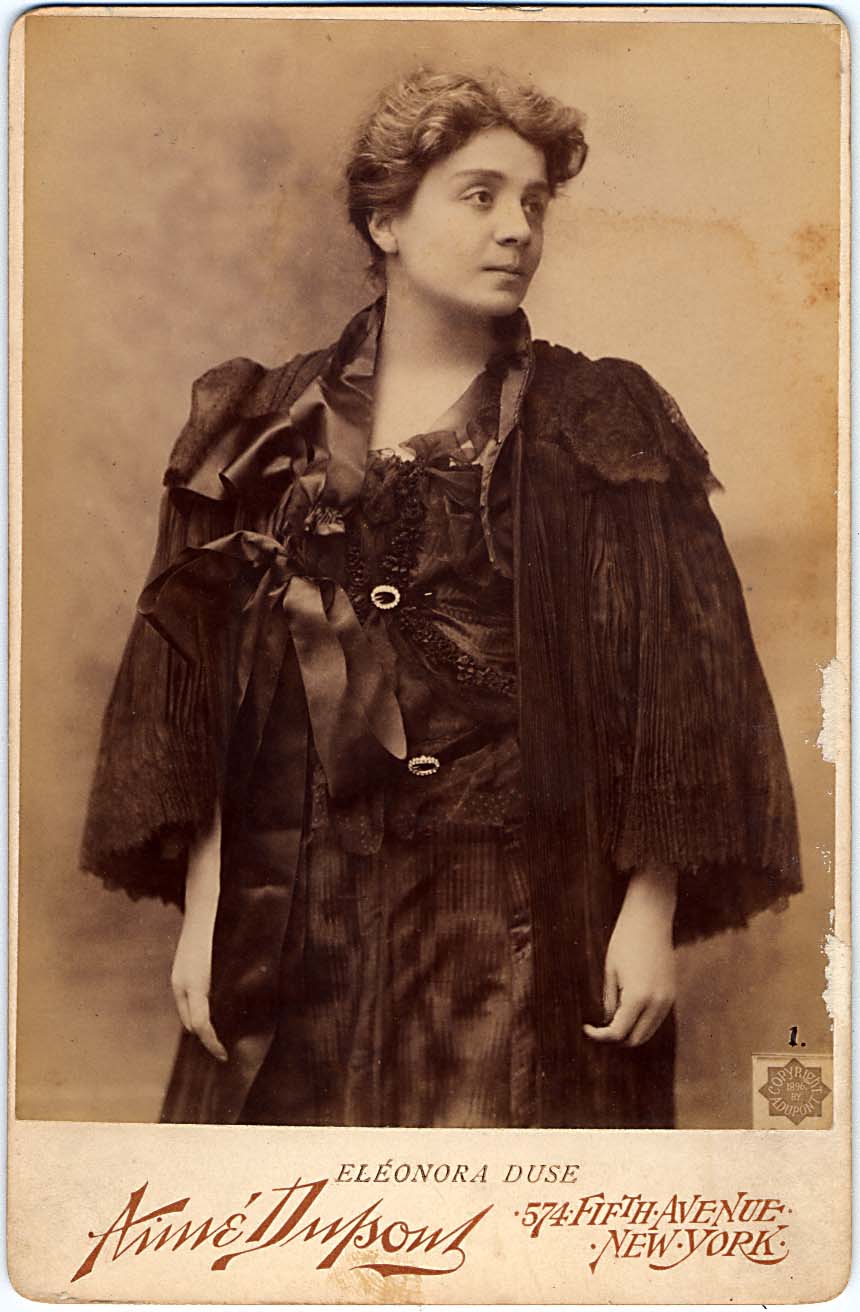

I was, of course, curious about the exact words of that "adamant oratory" and I immediately turned to Winwar's biography in search of the words by Shaw. Winwar, in his Wingless Victory - A Biography of Gabriele D'Annunzio and Eleonora Duse, indeed refers to the occasion when both actresses "decided to play Magda, Duse at the Drury Lane and Bernhardt at Daly's Theater" in what the author calls a "duel for supremacy." He goes on to describe how Shaw "voted unqualifiedly for Duse and defended his choice with trenchant oratory." No source, alas, is provided for this episode. 

A similar account is provided in Taranow's biography of Bernhardt, where he refers to Shaw as a "passionate Ibsenite" who "was negatively sensitive" to Bernhardt's performances. 

A much later biography of Duse (by Helen Sheehy) includes a reference to the same critical piece by Shaw and his opinions on Duse's performance. This time, we are only a little luckier in reading that it was written soon after Shaw had begun writing for The Saturday Review

Once this information is provided, it is easy to turn to any of the excellent edited collections of Shaw's dramatic criticism in order to find the relevant article. Specifically, "Duse and Bernhardt" (that was its title) was published on June 15, 1895. The full text of the article is available HERE. UNZ.org has also digitized this text and made it publicly available HERE. Other collections where the article can be read include Bernard F. Dukore's The Drama Observed (Vol. II, pp. 366-371)

Since I know you are more than capable of reading the article yourself and drawing your own conclusions, I will only bring to your attention how this article has been quoted and used in other media as an example of superb dramatic criticism and as the epitome of a certain kind of approach to acting. An approach that, as Shaw's article suggests, can tell "the difference between an effective part and a well-played one."

After the 2006 Academy Awards, for example, Shaw's less-than-Solomonic judgement on these two actresses was borrowed to illustrate how "beauty in acting has less to do with good genes (or a great plastic surgeon) than with the representation of human truth."

The rivalry between both icons of acting (together with the observations by Shaw) was dramatized in 2003, in a "frightening" face-off

"Duse and Bernhardt" was also included as an external element in a more recent adaptation of this historical competition, "The Ladies of the Camellias"

In fact, Shaw's "un-Shavian rapture" is the basis of Sheehy's biography of Duse, as suggested by this New York Times review.

In a more distant, convolute connection, Shaw is quoted in a review of a ballet coreography based on Duse's professional life (in German).  


Well, I hope this gives you an idea of how relevant a drama critic Bernard Shaw still is. I'm sure you all have your favorite in the Duse-Bernhardt duel, but nothing compares to Shaw's critical essays. 

Monday, March 28, 2016

EBENEZER HOWARD: ONE OF THOSE HEROIC SIMPLETONS WHO DO BIG THINGS

One of the publications I regularly check for Shaw-related essays is the Journal of William Morris Studies. The journal, which can be accessed freely on the website of The William Morris Society, often contains references to Shaw, whether because of their friendship or because of their shared interests (socialism, typesetting). The summer issue (2015) of the journal contains a brief reference to Shaw, quoted as saying that Ebenezer Howard was 

"One of those heroic simpletons who do big things whilst our prominent worldlings are explaining why they are Utopian and impossible."

These words are taken from a letter that Shaw wrote after Sir Ebenezer's death in 1928, addressed to A.C. Howard, his son. I guess he must have taken solace in the fact that someone like Shaw would say such things of his father. The letter has not been included, to my knowledge, in any of the collected Shaw correspondences, and is held as part of the Ebenezer Howard papers

Ebenezer Howard Grave

The Shavian twist, as usual, comes when we read the rest of the paragraph, which continues as follows: 

"And of course it is they who will make money out of his work."

Shaw is here probably referring to the success of Howard's inventions, like some printing machines for which he took out several patents. However, as many of you may know, Sir Ebenezer Howard is best known as the founder of the first "utopian" Garden Cities. Perhaps his ideas and prospects about these Garden Cities are best summarized in his Garden Cities of Tomorrow (1902), a thorough account of the different aspects that an ideal city should address. 

At any rate, what interests me the most about this quotation is not so much what it says or what it implies for the understanding of the figure of Ebenezer Howard. In this case, what I find of interest is that Shaw's words have been chosen to synthesize the spirit of Howard's urban dreams on countless occasions - thus indirectly conferring a great deal of authority to Shaw. 

Beevers, to begin with the obvious, quotes this passage in his critical biography of Howard. Likewise, the introduction to English Garden Cities published by English Heritage also chooses Shaw's words to epitomize the nature of Howard's plans. Even a recent article on an exhibition revisiting the legacy of William Morris mentions Howard twice, Shaw's words included. 


This is, in sum, another example of how Shaw manages to capture the elusive nature of human personality with his phenomenal command of words and ideas - perhaps he should have taken up playwriting!


Monday, March 7, 2016

SHAW AND THE CULT OF LINCOLN - ABRAHAM, THAT IS.

A few weeks ago, I was reading some new publications in order to decide whether their references to Shaw would be of interest to readers of the Continuing Checklist of Shaviana. One such publication was Nimrod Tal's The American Civil War in British Culture: Representations and Responses, 1870 to the Present. In chapter 3, "British Intellectuals and Abraham Lincoln" we read that "Bernard Shaw saw a cult of Lincoln in England" (p. 95), although no source is provided either in the text or in a note.

I tried to search for the source of these alleged words by Shaw in my database, but I could not find anything vaguely related to a "cult."

Luckily for me, however, this notion of Shaw's acknowledgment of a "cult of Lincoln in England" is to be found in other publications on the subject. So, for example, Adam I. P. Smith, in his article "The ‘Cult’ of Abraham Lincoln and the Strange Survival of Liberal England in the Era of the World Wars," not only cites Shaw as the source of these words, but in a footnote he provides three references where I expected to find the sources I was looking for. 

The first one is Mark E. Neely's The Abraham Lincoln Encyclopedia, where we can read (p. 53) that "George Bernard Shaw told Lincoln collector Judd Stewart that there was 'a cult of Lincoln in England, received of late from Lord Charnwood's very penetrating biography.'"


The source of Shaw's words is further corroborated by some documents that have been recently digitized from the Files of the Lincoln Financial Foundation Collection. These documents include a 1981 issue of Lincoln Lore, the Bulletin of the Louis A. Warren Lincoln Library and Museum, which was edited by the aforementioned Mark E. Neely. There, we read an almost verbatim reproduction of what he had written in his The Abraham Lincoln Encyclopedia: "George Bernard Shaw told Lincoln collector Judd Stewart that Charnwood's "very penetrating biography" created "a cult of Lincoln in England." 

Of course, although Shaw's opinion as quoted by Neely is plausible, we are still left with a personal record of a conversation of which there is no further evidence. Whether one chooses to take this with a grain of salt is a personal decision, but I cannot end this post without bringing to your attention the fact that Shaw read all the books about Lincoln we have just mentioned - and then some. 

If you search for "Lincoln" on the website of the National Trust Collections, and you limit your search to the items found in Shaw's Corner, you will find that Shaw owned copies of both Drinkwater's play and Charnwood's biography - as well as another biography of Lincoln by Basil Williams. 

Shaw may or may not have said that there was a "cult," but he was no doubt aware of the stature of Abrahm Lincoln as an icon of history and culture.


Wednesday, February 17, 2016

A REVOLUTION ALWAYS SEEMS HOPELESS AND IMPOSSIBLE THE DAY BEFORE IT BREAKS OUT

A few days ago I discovered that the terrorist who was responsible for the 2011 Norway attacks had written a manifesto in which he quotes Shaw twice. The first quotation is one of the aphorisms in "Maxims for Revolutionists," one of the addenda to Man and Superman, and it reads: 

"Liberty means responsibility. That is why most men dread it."

Reign of the Superman

The other quotation is a little bit more complex. Not only because the whole sentence has the usual convolute syntax that so many of us have grown to enjoy, but because it is part of a longer context that needs to be discussed as well. The quotation in question is the following: 

"A revolution always seems hopeless and impossible the day before it breaks out and indeed never does break out until it seems hopeless and impossible."

As many of you may remember, this fragment is from the Preface to Back to Methuselah. Specifically, it is part of the section called "The Betrayal of Western Civilization." In this section, before writing the sentence I have quoted above, Shaw is complaining about the abuses on the part of allegedly democratic governments in the form of censorship and repression (though not exclusively) because they are afraid.

"Statesmen are afraid of the suburbs, of the newspapers, of the profiteers, of the diplomatists, of the militarists, of the country houses, of the trade unions, of everything ephemeral on earth except the revolutions they are provoking; and they would be afraid of these if they were not too breaks out, and indeed never does break out until it seems hopeless and ignorant of society and history to appreciate the risk, and to know that a revolution always seems hopeless and impossible the day before it impossible; for rulers who think it possible take care to insure the risk by ruling reasonably."

In other words, what may seem like encouragement for revolutionists is actually a plea for reasonable government. This surprises no-one among Shavians, for we know Shaw was not a man of action. 

That is perhaps why Lenin called him "a good man fallen among Fabians."

That is perhaps why he decided to walk away from the Bloody Sunday riots.

That is perhaps why he joined and promoted a political (Fabian) society that was named after a Roman general that defeated Hannibal with delaying tactics.  

And that is perhaps why we find interesting connections between censorship and revolution in Shaw's writings. So, for example, we can read something to the same effect of the above in the Statement of the evidence in chief of George Bernard Shaw before the Joint-Committee on Stage Plays (1909).

"The Inquisition and the Star Chamber, which were nothing but censorships, made ruthless war on impiety and immorality. The result was once familiar to English­men, though of late years it seems to have been for­gotten. It cost England a revolution to get rid of the Star Chamber. Spain did not get rid of the Inquisition, and paid for that omission by becoming a barely third-rate power politically, and intellectually no power at all, in the Europe she had once domin­ated as the mightiest of the Christian empires."
Paradoxically (not quite), as he points out in his famous letter to H. M. Hyndman (28 April 1900), Shaw is a revolutionary himself, but a "moral revolutionary"

"I am a moral revolutionary, interested, not in the class war, but in the struggle between human vitality and the artificial system of morality, and distinguishing, not between capitalist & proletarian, but between moralist and natural historian." 

Shavians of the world, unite! 
G Bernard Shaw 2

Tuesday, January 26, 2016

BERNARD SHAW AND REPARTEE: UNDESERVING SUCH PRAISE.

A few weeks ago, my faithful Google Alerts brought to my email inbox an article in The New Indian Express that illustrates the concept of repartee by providing a number of examples. Notably, two of them have Bernard Shaw as one of the necessary protagonists. The first of them has already been discussed here, and has been discarded as completely apocryphal. The other one, however, I had never heard of. It goes like this: 

"Cornelia Otis Skinner won critical acclaim in the lead role of Shaw’s play Candida. Shaw cabled, “Excellent. Greatest.” Skinner, overjoyed, replied, “Undeserving such praise.” Shaw cabled back, “I meant the play.” Pat came the reply, “So did I.”"

If you Google the key words in this exchange, you will quickly realize that the anecdote has been quoted countless times, even if we only list articles that are available online, like this one, this one, or this one. However, no source is provided in any of the instances I've come across. Not even in books that claim to have researched the question, or in the secondary sources they cite.  

Of course, the first thing I did was to check my database and, there it was! There is at least one book that makes reference to this witty repartee. Although, as we shall see, it is not the most reliable of sources. The exact details follow. 

On page 249 of Allan Chappelow's Shaw the Villager and Human Being, we read how Dr. William Maxwell recounts a story that Shaw told him when he was staying with him in Edimburgh: 

"The scene was the 90's, when he was a music critic. He had been invited to a soirĂ©e in the house of a noted society lady. She had engaged a violinist (in whose career she had taken an interest) to entertain her guests—there were hundreds of them—and at the end of the evening, asked Shaw what he thought of her protĂ©gĂ©. He replied that the violinist reminded him of Paderewski. 'But Paderewski is not a violinist,' she said. ' Exactly,' replied G.B.S. !"

This paragraph ends with a footnote where the author goes on to say that "this amusing story prompted me to tell Dr. Maxwell the following one of a similar flavour." Of course, "the following one" is the story we have quoted at the beginning of this post.


Admittedly, Chappelow does not provide any other source but his own knowledge, and we cannot take his words as confirmation that the exchange between Shaw and Skinner ever took place. As we all know, Chappelow made Shaw's aquaintance when he visited him in 1950 (the year of Shaw's death) and took the last known photographs of him. Therefore, he can only have learned about this anecdote from secondary sources, and it is unlikely that Shaw should have ever mentioned this to him in person - Chappelow would  have probably included that information in his book.

In all, it seems that this quotation may well be apocryphal or, ultimately, impossible to confirm. There is nonetheless evidence to give credibility to this repartee. In 1943 (during Shaw's and Skinner's own lifetimes) Isabella Taves published a book entitled Successful Women and How They Attained Success. The chapter devoted to Cornelia Otis Skinner (pp. 69-78) also contains the same story, practically in the same words. 

Although I know of no data to confirm this, it is plausible to believe that either Shaw or Skinner (or both) might have come across this book - if the author did not send a complimentary copy herself. Wouldn't they have corrected Taves if the story weren't true? Who knows?


Cornelia Otis Skinner

Tuesday, January 19, 2016

POLITICS AND THE UNCOMMON MAN

I came across a somewhat lengthy quotation - allegedly by Shaw - the other day, as I was perusing an article about Greenwood Village's local election. Don't ask me why. 

The quotation reads as follows: 

“It is a curious fact that when we get sick, we want an uncommon doctor. If we have a construction job, we want an uncommon engineer. When we get into war, we want and uncommon admiral and an uncommon general. Only when we get into politics are we content with the common man.”

As usual, no source is provided. So I seached my database and... nothing! 

Well, it's no wonder. It turns out that none other than 
President Herbert Hoover pronounced these words as part of a telephone address from New York City to Wilmington College, Wilmington, Ohio on the occasion of the conference "Building For A Better Tomorrow." If you read the links below you'll see just how fitting the title was.  

The full text of the speech can be read at 
the Hoover Association's page, and you can see that it was later published as a booklet - a copy of which is available at the National Archives's site


HerbertClarkHoover


Well, another misattribution, another dollar. We know of many witticisms and other quotations that have been erroneously ascribed to Shaw. 

However, this blog has no interest in the words of American Presidents - 
except for the occasional Shavianism. In fact, political speeches - or, rather, the speeches of politicians - are practically anathema for Shaw. See, for instance, what he had to say about the way the politicians of his time delivered their speeches through the wireless: 

"Most of the politicians are awful. Lloyd George was bad enough, and Churchill is no better. Someone ought to tell them that their House of Commons style, with long pauses between every word to think out what they are going to say next, is pitiful through the mike, especially when they pronounce their prepositions and conjunctions as if they were speaking oracles."

The quotation is from 
Hesketh Pearson's Bernard Shaw: A Biography (p. 469), and many of my dear friends from the ISS should re-read at least that page because another thing Shaw is quoted as saying is "Do you know anything about these infernal Shaw Societies?"  

At any rate, since Shaw was actually referring to style rather than to content, I'll spare President Hoover, Winston Churcill and all other politicians, and publish the post all the same. 


Saturday, December 19, 2015

A FUNNY FREUDIAN? SLIP

Because this is not really a quotation, I am going to be brief. 

The other day I was searching for the latest publications on Bernard Shaw - I use Google Books and Google Scholar for that, among other repositories - when the title of one of the books that made reference to Shaw caught my eye. It was Ancient Rome and the Construction of Modern Homosexual Identities

It took me a while to find the two references to "Bernard Shaw" in the book, and it took me a while more to understand what was going on. 

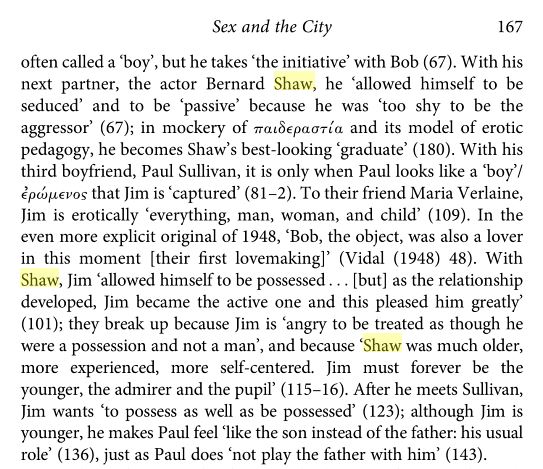
It turns out that in Chapter 8 ("Petronius' Satyrica and Gore Vidal's The City and the Pillar"), the author (Nikolai Endres) discusses the depiction of homosexual relationships between a young boy and an older man. When he describes the case of Jim in The City and the Pillar, he mistakes the name of the actor he has an affair with in the novel (Ronald Shaw) for that of Bernard Shaw. Thus, a rather unexpected paragraph follows, reproduced here: 


Although it is simply a small typographical error that does not subtract from the quality of the chapter, let this be a warning to all my readers about the perils of the internet. And also a token of the type of chaff that the editor of the Continuing Checklist of Shaviana has to separate from the wheat.