Wednesday, October 29, 2014

THE MEN OF IRELAND ARE MORTAL AND TEMPORAL, BUT HER HILLS ARE ETERNAL

These words can be read on the plaque erected on the wall of Torca Cottage, on Dalkey Hill. This house was the residence where Bernard Shaw spent much of his childhood - his parents forming a peculiar ménage-à-trois with George Vandeleur Lee


The quotation, however, is not from one of Shaw's plays or novels, but from a letter written a few months before this plaque was made. Already in his nineties, Shaw had become an object of culture in himself and arguably, the man of the century. Thus, in April 1947 John G. Fitzgerald, secretary of the Dalkey Development and Protection Association, suggested that a new park adjoining Killiney Hill be named after the playwright. Shaw wrote a letter to Mr. Fitzgerald indicating that "it must not be called Bernard Shaw Hill" because "not only would that be a clumsy ugly title, but out of the question because the men of Ireland are mortal and temporal and her hills are eternal." With the sole exception of the use of "and" instead of "but," there is no question that this is the source of the quotation on the plaque. 

The full text of this letter can be read on pages 793-4 of the fourth volume of Bernard Shaw Collected Letters (1926-1950)


Friday, October 24, 2014

NO MAN FULLY CAPABLE OF HIS OWN LANGUAGE EVER MASTERS ANOTHER

Although - as a member of a Philology Department - I know a few people who are living proof that the above quotation is less than accurate, it is hard to tell to what extent Shaw's words are true - especially because there is no definition of what "fully capable" means. What I can tell you, though, is that these words can be found in Maxims for Revolutionists, a sort of annexe to The Revolutionist's Handbook and Pocket Companion. This, in turn, is an addendum to Man and Superman, as many of you already know. 

Shaw's interest in foreign languages was rather limited, with the exception of the translation of his plays. Whether because of the incompetence of many of his translators or because he wanted to oversee everything concerning the publication of his works, Shaw exchanged a number of letters over specific words, phrases or passages in translation. His Collected Letters contain many examples of these, particularly with the Hamons (Augustin and Henriette), his French translators, and with Siegfried Trebitsch, the German one. 


On a more personal note, however, Shaw was quite aware of his lack of ability for foreign languages, as he conceded on a number of occasions. Perhaps one of the most oft-quoted anecdotes in this respect is recounted in his letter to Dino Grandi, Italian ambassador to Britain at the time, who had invited the Shaws to dine. (Bernard Shaw Collected Letters Vol. IV, p. 371-2) Shaw politely declined the invitation, partially on the grounds of what had happened the last time: 

"Your lady graciously came and spoke to me. I lost my head completely and tried to speak in Italian (which I cannot speak). The result was a stammering in very bad French (I am the worst of linguistis - not like you, who speak English better than any Englishman). It was evident to the Signora Grande that I was very drunk; and the conversation ended abruptly before I recovered my presence of mind."

Despite these shortcomings, Shaw was regarded by some as a very good speaker of a few foreign languages - although for reasons beyond his actual mastery of any of them. As Archibald Henderson puts it in his Bernard Shaw: A Critical Biography (p. 492):

"[Shaw] speaks no language but his own, and reads no foreign language, save French, with ease. I remember hearing someone ask Rodin whether Shaw really spoke French. "Ah! no!" replied Rodin, with his genial smile and a faint twinkle of the eyes; "Monsieur Shaw does not speak French. But somehow or other, by the very violence of his manner and gesticulation, he succeeds in imposing his meaning upon you!" Shaw is fond of relating the incident which laid the foundation for his reputation as an Italian scholar. “Once I was in Milan with a party of English folk. We were dining at the railway restaurant, and our waiter spoke no language other than his own. When the moment came to pay and rush for the train, we were unable to make him understand that we wanted not one bill, but twenty-four separate ones. My friends insisted that I must know Italian, so to act as interpreter, I racked my memory for chips from the language of Dante, but in vain. All of a sudden, a line from The Huguenots flashed to my brain: Ognuno per se / per tutti il ciel (‘Every man for himself / and heaven for all) I declaimed it with triumphant success. The army of waiters was doubled up with laughter, and my fame as an Italian scholar has been on the increase ever since.”


At any rate, nobody can blame Shaw for trying to pass as a great linguist. As he himself acknowledged in a note he wrote on the occasion of the premiere of The Devil's Disciple at the Raimund Theatre, Vienna (the manuscript is transcribed and annotated in The Annual of Bernard Shaw Studies, Vol. 20, pages 247-252): 

"Like all really able men I am congenitally incapable of acquiring foreign languages; but I have been so steeped in German music, and consequently in German poetry, all my life (having indeed learned more of my art as a writer for the stage from Mozart than from Shakespear, Molière or any literary dramatist) that I cannot help believing that I know German. I sometimes speak it; and my German friends are all agreed that nobody else in Europe speaks it in quite the same manner."


"Shaw and Foreign Languages and Literature." Sounds like something someone should write a book on. 

Wednesday, October 15, 2014

THE STATESMAN WHO HAS NO OTHER OBJECT THAN TO MAKE YOU VOTE FOR HIS PARTY

A couple of days ago, Lizzie Dunford, assistant house steward at Shaw's Corner and avid blogger, posted an interesting quotation by Shaw on her Facebook timeline: 


"The statesman who has no other object than to make you vote for his party at the next election may be starting you on an incline at the foot of which lies war, or revolution, or a smallpox epidemic, or five years off your lifetime." 

The quotation, as Lizzie rightly notes, belongs to a 1911 piece. Specifically, to the Preface to Three Plays by Brieux, a book containing the English translation of three works by French playwright Eugène Brieux. The book was published by Brentano and contained two different versions of Maternity - one of them translated by Charlotte Shaw, and the other by John Pollock. Together with the two versions of Maternity, the volume also included The Three Daughters of M. Dupont (trans. by St. John Hankin) and Damaged Goods (trans. by John Pollock). 

What seems odd about this quotation - at least when taken out of context - is that one may get the impression that Shaw is yet again grinding the axe of Fabian socialism and political reformation. Although that is partially the case, for Shaw never wrote a single line "for art's sake," the expanded context clarifies that Shaw is, by and large, trying to illustrate how the true dramatist, the man of genius, has a moral obligation to "interpret life." In other words, those who have got it must exert their "power of accurate observation" in order to educate, rather than "amuse themselves or their audiences." 

I reproduce the whole paragraph below for the amusement (and enlightenment) of my readers, in an attempt to "pick out the significant incidents from the chaos of daily happenings, and arrange them so that their relation to one another becomes significant." 

"But the great dramatist has something better to do than to amuse either himself or his audience. He has to interpret life. This sounds a mere pious phrase of literary criticism; but a moment's consideration will discover its meaning and its exactitude. Life as it appears to us in our daily experience is an unintelligible chaos of happenings. You pass Othello in the bazaar in Aleppo, lago on the jetty in Cyprus, and Desdemona in the nave of St. Mark's in Venice without the slightest clue to their relations to one another. The man you see stepping into a chemist's shop to buy the means of committing murder or suicide, may, for all you know, want nothing but a liver pill or a toothbrush. The statesman who has no other object than to make you vote for his party at the next election, may be starting you on an incline at the foot of which lies war, or revolution, or a smallpox epidemic, or five years off your lifetime. The horrible murder of a whole family by the father who finishes by killing himself, or the driving of a young girl on to the streets, may be the result of your discharging an employee in a fit of temper a month before. To attempt to understand life from merely looking on at it as it happens in the streets is as hopeless as trying to understand public questions by studying snapshots of public demonstrations. If we possessed a series of cinematographs of all the executions during the Reign of Terror, they might be exhibited a thousand times without enlightening the audiences in the least as to the meaning of the Revolution: Robespierre would perish as "un monsieur" and Marie Antoinette as "une femme." Life as it occurs is senseless: a policeman may watch it and work in it for thirty years in the streets and courts of Paris without learning as much of it or from it as a child or a nun may learn from a single play by Brieux. For it is the business of Brieux to pick out the significant incidents from the chaos of daily happenings, and arrange them so that their relation to one another becomes significant, thus changing us from bewildered spectators of a monstrous confusion to men intelligently conscious of the world and its destinies. This is the highest function that man can perform — the greatest work he can set his hand to; and this is why the great dramatists of the world, from Euripides and Aristophanes to Shakespear and Moliere, and from them to Ibsen and Brieux, take that majestic and pontifical rank which seems so strangely above all the reasonable pretensions of mere strolling actors and theatrical authors."


Hotung and GBS 1933


Tuesday, October 14, 2014

I EXHAUSTED RATIONALISM WHEN I GOT TO THE END OF MY SECOND NOVEL

A few days ago, Richard Dietrich could not find the source for the following lines and asked for a hand: 

"I exhausted rationalism when I got to the end of my second novel at the age of twenty-four, and should have come to a dead stop if I had not proceeded to purely mystical assumptions.  I thus perhaps destroyed my brain, but inspiration filled up the void, and I got on better than ever."

This is an excerpt from a letter to Dame Laurentia McLachlan, dated 23rd December 1924. The letter and the process of locating it as the source of the above words made me think about a tangential aspect of Shaw studies. 

I started thinking about how important redundancy is for research in the humanities, despite being a source of inconsistency in other data sets. In this particular case, the same fragment is reproduced in several different publications, which facilitated my job a great deal. Specifically, one can find references to this letter (or the whole document) in Bernard Shaw Collected Letters (Vol. 3, pages 896-8); in The Nun, the Infidel, and the Superman (pages 93-5); in Berst's "The Poetic Genesis of Shaw's God," in the first issue of the SHAW: The Annual of Bernard Shaw Studies (page 22); and in Leon Hugo's Bernard Shaw's The Black Girl in Search of God: The Story behind the Story (Page 96). After quadruple-checking my results, I did not continue reading the results page but, at any rate, the point is that, had I not digitized any of those books, I still would have been able to track the source indirectly. I guess this is one of the reasons why a broad and eclectic digitized library of Shaw's plays and secondary sources (biographies, criticism, programs of productions) is an invaluable asset for research on Shaw. 

Until time (meaning copyright restrictions) allows me to publish my database and let others access it freely, I like to think that I can do a humble public service for Shavians. So, if you can't find a source, drop me a line (garoma@unex.es).


Friday, October 3, 2014

THAT IS WHY MANY PEOPLE WHO TAKE THEIR CHILDREN TO THE THEATER DO NOT SEND THEM TO CHURCH

In a coincidence that has become customary lately, both the International Shaw Society and Shaw's Corner have posted the same Shaw quotation on their Twitter feed. 


It is a bemusing quotation indeed, for what is it that makes people take their children to the theatre and not to church? The reason can be found in the original context of this excerpt, which I reproduce below:

 - Your question “Is the Theatre a power making for righteous­ness?” is as useless as the same question would be about Religion or Gravitation or Government or Music. There are theatres in England in which the entertainment on the stage is simply a device to lure people to the drinking bars which are the real sources of profit to the manager. There are theatres everywhere which deal in nothing but dramatic aphrodisiacs. And there are theatres which deal with more serious representations of life and greater achievements of literary art than any to be found in the grossly overrated bundle of Hebrew literature which you were taught to idolize to the exclusion of your natural literary birthright. Between these extremes lie every possible grade of theatre; and to lump them all as an unreal abstraction called “the theatre” will only land you in confusion. A theatre is a potent engine for working up the passions and the imagination of mankind; and like all such engines it is capable of the noblest recreations or the basest debauchery according to the spirit of its direction. So is a church. A church can do great things by precisely the same arts as those used in the theatre (there is no difference fundamentally, and very little even superficially); but every church is in a state of frightful pecuniary dependence on Pharisees who use it to whitewash the most sordid commercial scoundrelism by external observances; it organizes the sale of salvation at a reasonable figure to these same Pharisees by what it calls charity; it invariably provides occasion for envy and concupiscence by an open exhibition of millinery and personal adornment for both sexes; and it sometimes, under cover of the text that God is love, creates and maintains a pseudo- pious ecstatic communion compared to which the atmosphere of the theatre is prosaically chilly. That is why many people who take their children to the theatre do not send them to church. The moral is, as “pagans like Domitian and Trajan” saw, that both churches and theatres need to be carefully looked after so as to prevent them from abusing their powers for pecuniary profit. - 

This paragraph is part of a longer letter, probably dated c. Jul. 1904, and addressed to William T. Stead.  The full text can be read on pages 424-6 of Dan H. Laurence's edition of Bernard Shaw's Collected Letters (Vol. II).  

One of the main ideas of the passage, the notion that "every church is in a state of frightful pecuniary dependence on Pharisees," also made its way into many other of Shaw's works, particularly the prefaces to his plays - often in quite memorable ways as well. 

For example, in the Preface to Major Barbara, Shaw explains that one of the things the Salvation Army and Barbara discover in the play is that "there is no salvation for them through personal righteousness, but only through the redemption of the whole nation from its vicious, lazy, competitive anarchy." This is yet another sense in which playgoers and Pharisees seem to concur. After all: 

"this discovery has been made by everyone except the Pharisees and (apparently) the professional playgoers, who still wear their Tom Hood shirts and underpay their washerwomen without the slightest misgiving as to the elevation of their private characters, the purity of their private atmospheres, and their right to repudiate as foreign to themselves the coarse depravity of the garret and the slum."


Nicolas Colombel - Christ Expelling the Money-Changers from the Temple

This concept may derive from earlier ideas, perhaps rather more revolutionary and, to some extent, naive. Look, for instance, at the following passage from the Preface to Immaturity (Shaw's first novel). 


"Christ adapted himself so amiably to the fashionable life of his time in his leisure that he was reproached for being a gluttonous man and a winebibber, and for frequenting frivolous and worthless sets. But he did not work where he feasted, nor flatter the Pharisees, nor ask the Romans to buy him with a sinecure. He knew when he was being entertained, well treated, lionized: not an unpleasant adventure for once in a way; and he did not quarrel with the people who were so nice to him. Besides, to sample society is part of a prophet's business: he must sample the governing class above all, because his inborn knowledge of human nature will not explain the anomalies produced in it by Capitalism and Sacerdotalism. But he can never feel at home in it. The born Communist, before he knows what he is, and understands why, is always awkward and unhappy in plutocratic society and in the poorer societies which ape it to the extent of their little means: in short, wherever spiritual values are assessed like Income Tax."

In other words, the "pecuniary dependence" of the present-day churches may have to do with this "sampling of society" and the fact that the real essence of Christianity has not been realized yet - in more ways than one. Perhaps the key to all this may lie in the general misunderstanding as to what "modern communism" actually means. I'll leave you with Shaw's explanation, from the Preface to Androcles and the Lion

"Now let us see what modern experience and modern sociology has to say to the teaching of Jesus as summarized here. First, get rid of your property by throwing it into the common stock. One can hear the Pharisees of Jerusalem and Chorazin and Bethsaida saying, "My good fellow, if you were to divide up the wealth of Judea equally today, before the end of the year you would have rich and poor, poverty and affluence, just as you have today; for there will always be the idle and the industrious, the thrifty and the wasteful, the drunken and the sober; and, as you yourself have very justly observed, the poor we shall have always with us." And we can hear the reply, "Woe unto you, liars and hypocrites; for ye have this very day divided up the wealth of the country yourselves, as must be done every day (for man liveth not otherwise than from hand to mouth, nor can fish and eggs endure for ever); and ye have divided it unjustly; also ye have said that my reproach to you for having the poor always with you was a law unto you that this evil should persist and stink in the nostrils of God to all eternity; wherefore I think that Lazarus will yet see you beside Dives in hell." Modern Capitalism has made short work of the primitive pleas for inequality. The Pharisees themselves have organized communism in capital. Joint stock is the order of the day. An attempt to return to individual properties as the basis of our production would smash civilization more completely than ten revolutions. You cannot get the fields tilled today until the farmer becomes a co-operator. Take the shareholder to his railway, and ask him to point out to you the particular length of rail, the particular seat in the railway carriage, the particular lever in the engine that is his very own and nobody else's; and he will shun you as a madman, very wisely. And if, like Ananias and Sapphira, you try to hold back your little shop or what not from the common stock, represented by the Trust, or Combine, or Kartel, the Trust will presently freeze you out and rope you in and finally strike you dead industrially as thoroughly as St. Peter himself. There is no longer any practical question open as to Communism in production: the struggle today is over the distribution of the product: that is, over the daily dividing-up which is the first necessity of organized society."


Androcles Peruzzi


Monday, September 22, 2014

SHAW IN THE OED

Shaw is one of the most oft-quoted authors in the Western world - do I really need to remind anybody of this? Sometimes, however, he is not quoted because of his sharp language, his witty choice of words, and his brilliant ideas. On some occasions, the lexicographers of this world choose Shaw to illustrate words one does not come across all that often. That is the case, for example, of the highest authority in English dictionaries: the OED

All the words in the Oxford English Dictionary include a selection of quotations from different authoritative sources that illustrate the meaning and use of each entry. I am going to reproduce a few of the Shaw quotations the OED selected, together with the words they illustrate - especifically in those cases in which Shaw is either allegedly the first person to have used that word, or one of the few people to have put it in print. This includes neologisms of all sorts: new word-combinations, foreign loan-words, creative derivations, and the like. I guess this is as good a way as any to demonstrate how creative Shaw was in all the areas of knowledge he touched on. 

Actress
3.3 Comb. actress-manageress (cf. actor-manager). 
   1894 G. B. {Shaw} in W. Archer Theatr. ‘World’ 1893 Pref. p. xxix, The time is ripe for the advent of the actress-manageress.   
______________________________________________________
Anschauung
2.2 An outlook, attitude, or point of view. 
   1907 G. B. {Shaw} Major Barbara Pref. 148 The Shavian Anschauung was already unequivocally declared.    1922 Internat. Jrnl. Psycho-anal. III. 377 In many respects however they‥are merely ‘points of view’ (Anschauungen).
______________________________________________________
Bardolatry
Worship of the ‘Bard of Avon’, i.e. Shakespeare. (Occas. used of other writers.) So bardolater (-ˈɒlətə(r)) [-olater], a worshipper of the Bard, a Shakespearolater; barˈdolatrous a., tending to or characterized by bardolatry. 
   1901 G. B. {Shaw} Plays for Puritans Pref. p. xxxi, So much for Bardolatry!    1903 ― Man & Superman Ep. Ded. 30 Foolish Bardolaters make a virtue of this after their fashion.    1905 ― in Sat. Rev. 11 Feb. 170/2 The word ‘pity’ does not reach even the third row of the stalls, much less the gaping bardolatrous pit.    1911 Times Lit. Suppl. 9 Nov. 440/3 Playing for the sympathy of the ‘bardolaters’.    1914 G. B. Shaw Dark Lady Pref. 112 The familiar plea of the Bardolatrous ignoramus, that Shakespear's coarseness was part of the manners of his time.
______________________________________________________
Downstart
(See quot. 1949); also, one who pretends to be of lower origin than he is. Also attrib. 
   1898 G. B. {Shaw} Sixteen Self-Sketches (1949) viii. 44 My father was an Irish Protestant gentleman of the downstart race of younger sons.    1921 ― Pref. to Immaturity in Prefaces (1934) xxiii. 627/1, I was a downstart and the son of a downstart.    1949 ― Sixteen Self-Sketches ii. 7 The Downstart, as I call the boy-gentleman descended through younger sons from the plutocracy, for whom a university education is beyond his father's income, leaving him by family tradition a gentleman without a gentleman's means or education, and so only a penniless snob.
______________________________________________________
Flagellomania
Enthusiasm for flogging. Hence ˌflagelloˈmaniac n. and a., (one who is) enthusiastically in favour of flogging. 
   1895 G. B. {Shaw} in Daily Chron. 24 Feb. 8/5 Flagellomania has been victorious by seven votes to five on the Industrial Schools Committee.    1899 ― in Humanity May 136/2 The male flagellomaniac—who is sometimes, unfortunately, a judge—craves intensely for the flogging of women.    1908 Humanitarian Sept. 66/2 We are constantly assured by the flagellomaniac section of the Press that crime is ‘stamped out’ by the ‘cat’.    1917 G. B. Shaw in New Republic 6 Jan., Any newspaper can get up a flagellomaniac garotting scare. 
______________________________________________________

These are just a few (some of my favourites) of the 3080 quotations in 2527 entries that the CD-ROM version of the OED I own retrieves. If you can spare a few hours and want to do your own query, this is how you perform this search in v. 4.0

First, you open the main window and click on "dictionary." 


Then, you go to "advanced search," where you have to type "Shaw" in the first box and select "in quotation author."


Once you hit "start search," something like this will pop up, where you can scroll down the list of words whose definitions are illustrated by a Shaw quotation. 


Clicking on an entry will take you to the definition, where you can search for the relevant part by using the "find in entry" box at the bottom.


If you want to go back to the list of definitions, you just have to click on "results."


To wrap things up, I find it rather ironic that among the 46 dictionaries that Shaw kept at his Ayot St. Lawrence residence, none of them is the Oxford English Dictionary, and only two of them are Oxford dictionaries. Perhaps the sheer size of the print version of the OED was too much for a man who managed to write sixty-odd plays with pen, pencil, a typewriter, and a small rotating hut.

George Bernard Shaw notebook

Thursday, September 18, 2014

DIGITIZING SHAW - THE SHAW QUOTATION DATABASE

My countless followers and readers - "countless" meaning that I don't usually count them - are surely wondering why the blog has been kind of slow as of late. The answer is simple: I'm digitizing stuff. 

I would like to explain how my database came into being by utilizing the materials I'm currently digitizing as an example. In this case, I got a large parcel in the mail that contained an almost complete collection of The Shavian (in its various formats and denominations) ranging from the first-ever 1946 issue to the latest issue (2014). 


The parcel had been kindly sent by Evelyn Ellis, who took the trouble to put every issue into individual envelopes and include a complete index of what was included. Once open, the complete collection looked like this: 


So, as I usally do in what's left of my lunch break and other lapses of downtime, I lock myself in the photocopying room, where the new scanner of the English Philology Department at the Universidad de Extremadura awaits. 


If you look closely at the above picture, you'll see a black memory drive sticking out on the side of the machine. That's where everything I digitize goes, so that I can later edit the documents with the aid of this OCR software

Given that the Shavians are bound documents, I have to scan them one page at a time, with the additional handicap that they do not fit the standard A4 paper size. Therefore, I have to make use of state-of-the-art technology (a ruler!) and type in the width and length of the issue in question (expressed in millimeters). 


Although you can save any given measurements for later use, you may be surprised to know that not all Shavians are alike (pun intended!) For example, whereas most of them are 280x215 mm; number 7, however, is 250x185mm - to mention but one of the several cases in which I had to input a different scanning size. Once you know the area of the spread pages of a given issue, you just have to type in the numbers - always bearing in mind the orientation; i.e. what the x and y axis are. 


After all this, the process becomes quite straightforward: you just have to scan each page in succession, trying to silence the symptoms of the carpal tunnel syndrome you're slowly developing

Still, there are a few things that slow down the whole routine. For example, many of the issues are missing the staples that bind them, which means that you have to be extra careful not to let the page slant out of the scanning area. 


On occasion, the staples leave ugly rust marks in the middle of the page. Luckily, they do not usually impede the digitation and can be later erased or ignored when the document is edited. 


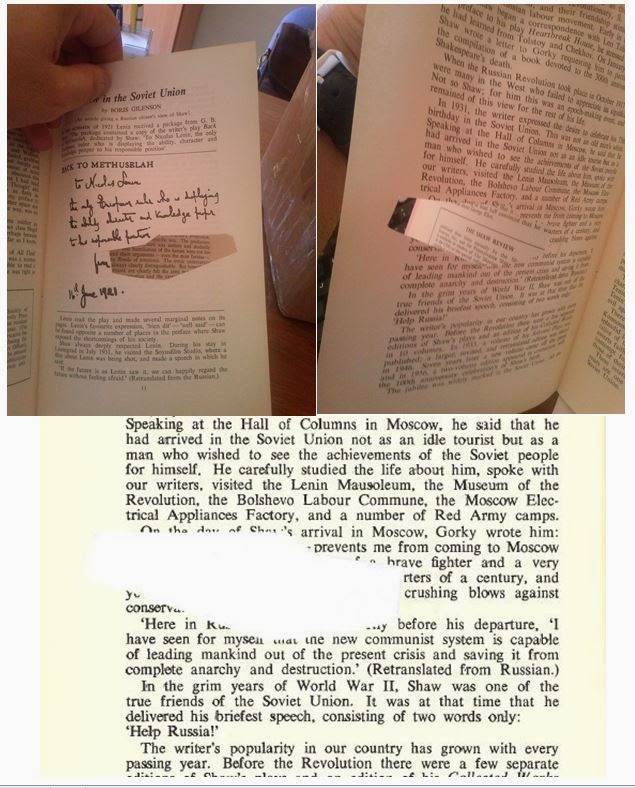
There are even some issues with holes cut out in them. In these cases, I've had to put a blank piece of paper behind the page, so that I would not scan what's on the following page through the hole. In the next three images, for example, someone had cut out Bernard Shaw's signature from the reproduction of a manuscript dedicatory. The hole, of course, spoiled the running text on the next page and the resulting scanned page, as you can see. 


Despite all these difficulties, there were some unexpected findings that really spiced up this project. Several issues had different kinds of addenda (donation slips, book advertisements, minutes and reports of the UK Shaw Society) that may become invaluable material if someone ever writes a not-so-short history of the Shaw Societies of this world. A few of these are reproduced in a presentation below. 


Well, I hope you liked what I had to share about one of my current projects. At least now you know why I'm not picking up the phone lately.