Tuesday, February 24, 2015

SHAW: THE PUGILIST AGAINST THE WORLD

A lot of what this blog is about has to do with analyzing Shaw as an object of culture. In other words, I try to take a look at GBS (the persona behind the man) so as to gain a better understanding of what has granted him such enduring popularity. In this sense, it is always interesting to look at the reception Shaw had in his lifetime, and the image he projected. 

Don't be afraid. What's coming is not a lengthy, cumbersome essay on how scholars, critics, and the like viewed Shaw. Instead, I've chosen to show here a short clip (just 10 seconds long. You surely can spare that, can't you?). It belongs to a 1933 Warner Brothers cartoon entitled "I've Got to Sing a Torch Song." As you may know, that was also the title of a popular song at the time, featured in the film of the same year "Gold Diggers of 1933." Let me begin by embedding the video with the music. 


Bernard Shaw is among the many celebrities that are portrayed in the film - more or less overtly. For example, there's a guy singing in the tub who has a sign that reads "Cros Bingsby" on his door. 

This is the Shaw part- judge for yourselves!


Given that this is a satirical portrayal of Shaw, there are a few things that are worth commenting on. All these aspects are proof of the image that the general public had of him. 

To begin with, it seems quite clear that Shaw's interest in boxing was widely known. It suffices to turn over a few pages of Jay Tunney's The Prizefighter and the Playwright to find out more about that. Therefore, it is not surprising that he should be depicted as a thin pugilist punching a globe. 


In addition, the idea that Shaw is punching a globe is, of course, a representation of his attempts at "world-betterment," of his revolutionary, shocking ideas, and of the general opposition he met along the way. Shaw always had an axe to grind, and always found someone to wield it against. 

Then, again, the globe bounces back at him and knocks him out. The metaphor leaves little room for interpretation. This is especially meaningful in light of the events that unfolded during the thirties, because it was then that Shaw had a rude awakening from his dreams of utopia - especially after the deeds perpetrated by the strong rulers of Europe he admired (Mussolini's cartoon alter-ego appears right before Shaw in the movie).

Finally, all the pictures of himself on the wall suggest an aura of conceit and self-awareness that was not very far from the truth, at least in what respects to his playwrighting persona. However, Bernard Shaw was a very friendly and humane person, as his neighbors and acquaintances recall. Many visitors would not even recognize him when they walked past him along the roads of Ayot St Lawrence. Such was his naturalness.  

To wrap things up, it would be nice to connect this cartoon to many other caricatures and satiric drawings in which Shaw has been depicted. Many of those can be accessed online on the digital image repositories of universities and other institutions. In my personal opinion, the collections of the British Cartoon Archive are especially interesting. 


George Bernard Shaw by Edmund S. Valtman ppmsc.07950

Thursday, February 19, 2015

A MAN NEVER TELLS YOU ANYTHING UNTIL YOU CONTRADICT HIM

This is probably one of the most popular quotations in Shaw's repertoire. Indeed, photographs like this one abound on the Internet. 


The quotation originated in a letter Shaw sent to Ellen Terry (28 Aug. 1896), included in Bernard Shaw Collected Letters Vol. I (1874-1897), p. 645.

"But I dread success. To have succeeded is to have finished one’s business on earth, like the male spider, who is killed by the female the moment he has succeeded in his courtship. I like a state of continual becoming, with a goal in front and not behind. Then, too, I like fighting successful people; attacking them; rousing them; trying their mettle; kicking down their sand castles so as to make them build stone ones, and so on. It develops one’s muscles. Besides, one learns from it: a man never tells you anything until you contradict him."


From the point of view of "contradiction" as a powerful tool to mine out the truth from people, Shaw followed what he preached. In another letter to Ellen Terry (25 Nov. 1905), he probed her thoughts on whether she considered Frederick Kerr to be the best option to play Brassbound in these terms: 

"Unless you contradict me, I shall assume that you prefer him to the available alternatives."

Of course, this tecnique - although effective - was not without detractors. As we can read in an article by Tom Miller (The Shavian 8.8, 2000), professor Harold J. Laski did not enjoy Shaw as a provocateur who fostered conflicting arguments, especially because Shaw seemed to have the sympathetic upper hand from his audience: 

"He talks as though he knows that Europe is listening at the keyhole to what he says; and he has, consequently, a reckless disregard for truth where this is in conflict with sensation that I really find a painful thing. And the adulation which surrounds him is irritating beyond words. He says something which makes you revolt; you contradict; and his audience looks at you as though you had spat upon the Eucharist." (8 Jan. 1928)

This is not to imply that Shaw would not "contradict himself" from time to time, as we all know. To quote but one - should I say momentous - example, Beatrice Webb records in his typescript diary (24 May 1927) that while she was "reading proofs of The Intelligent Woman's Guide to Socialism and Capitalism" together with her husband, she pointed out to Shaw that he had "contradicted himself more than once in the book." In Beatrice's recollection of the event, Shaw was "rather impressed especially as I insisted that I did not want him to alter anything he had written."

I wonder if self-contradiction was Shaw's way of getting the truth out of himself?

By the way, Beatrice Webb's both manuscript and typescript diaries are digitized and freely available at the LSE Digital Library. A phenomenal initiative and an endless lode of information for research. 

Beatrice Webb, c1875

Tuesday, February 10, 2015

MOST VOTED PLAYS

Here are the results of the poll I shared a couple of weeks ago. It will remain open until further notice, so you can still vote HERE

There seems to be a consensus among respondents that the five MVPs (Most Valuable Plays) in the Shavian canon are Man and Superman, Heartbreak House, Major Barbara, Pygmalion, and Saint Joan. Even if these results are as valid as those of the Eurovision Song Contest, it is still a nice conversation starter, I guess. 


Tuesday, January 27, 2015

SHAW: "IT'S MY BEST PLAY"

A few days ago I discovered an article - whose author is a professor at the Erasmus School of Economics - on when Nobel Prize laureates in literature had peaked in their production. That is to say, "When did Nobel Prize Laureates in Literature Make Their Best Work?" The idea is simple - like most good ones - you take all the Nobel laureates in literature and determine how old they were (and how far into their life span) when they produced their finest work. The tables in the article speak for themselves, so I am not going to reproduce - let alone interpret - their data. What I found puzzling, though, is how one is supposed to determine what the best work of an author is. It may be obvious in a few odd instances, but not so much in the case of Shaw. To add fuel to the fire, the play that is taken as Shaw´s milestone to determine his peak productivity is Arms and the Man.  

Arnold Daly 002


So I took matters into my own hands and created a little survey (available here, and still accepting responses) to share among the Shavians I could forward the form to. The final results will be published in a few days

This, of course, led me to think about whether Shaw himself had ever said anything as to which play was his best. After all, this is a blog for Shaw quotations. Well, as usual, Shaw had something to say about that, too. Apart from other statements that were modalized in ways that are open to interpretation, I think three specific passages stand out among the rest. 

First, in a letter to Ellen Terry (dated May 28, 1897) he writes that Mrs Warren's Profession is "much my best play; but it makes my blood run cold: I can hardly bear the most appalling bits of it. Ah, when I wrote that, I had some nerve." Admittedly, the letter was sent long before he had written many of the other masterpieces of drama that can arguably be measured against Mrs Warren's Profession

Also, in an inscription to Frank Harris under a list of six of his plays (Heartbreak House, Great Catherine, O’Flaherty VC, The Inca of Perusalem, Augustus Does His Bit, and Annajanska), he highlights Heartbreak House and notes that it was "rightly spotted by the infallible eye of Frank Harris as My Best Play." This anecdote is quoted in the Dictionary of Literary Biography Yearbook: 2001 , and duly annotated, as usual, by John R, Pfeiffer in the "Continuing Checklist of Shaviana" (SHAW 23)

Finally, my favourite. As many of you probably remember, the preface to Shakes Versus Shav begins with the words: "This in all actuarial probability is my last play and the climax of my eminence, such as it is." Regardless of the obviously comic tone of the whole piece, it is interesting to note how little an author cares about posterity when he realizes that he is losing control over what his works mean and how they are represented


Wednesday, January 21, 2015

QUOTATIONS MAKE A PLAYWRIGHT GREAT

I have just finished reading a very interesting article, especially for people who are into distant reading, data mining, computational linguistics, and digital text forensics - you know, all those things that allow us to play with computers at work and still get away with it. 

The article reports on a recent study published in Proceedings of the National Academy of Sciences,which suggests that "the most accurate predictions of which movies the U.S. Library of Congress will deem 'culturally, historically, or aesthetically significant' are not the views of critics or fans but a simple algorithm applied to a database." The conclusion to all this is that the more "connections" a movie has (and, I guess, any work of art, for that matter), the more likely it is to go down in the records as "culturally, historically, or aesthetically significant." 


Ancientlibraryalex

By connections, the scientists responsible for this study mean "films, television episodes and other works that allude to an earlier movie." In other words, when we hear "may the force be with you" quoted in a TV series episode, or we see lightsabers in different sci-fi movies, we are witnessing some of the things that turned Star Wars into a worldwide acclaimed classic. 


Regardless of the mathematics behind this algorithm, and the computer power needed to test it, we can certainly draw a parallelism between movies and drama - especially Bernard Shaw's plays. If the amount of quotations, allusions, recreations, and adaptations of Shaw's works is any indication of future status, we may rest assured that he will remain in the canon for years to come. 

Few authors figure more prominently in any dictionary of quotations; many of his plays have been adapted into movies or musicals (from My Fair Lady to The Chocolate Soldier); and he has coined words and phrases that have become part of the English lexicon. There are people who have even had to set up a blog to discriminate between quotations that are Shaw's and those that are apocryphal. Although, to be fair, sometimes someone else does the job for me

I hope you have enjoyed this little reflection for a change. As someone said once: "the golden rule is that there are no golden rules." 

Well, so long!


Wednesday, January 14, 2015

META-QUOTATIONS, INTERTEXTUALITY, AND "YOUTH IS WASTED ON THE YOUNG."

I have recently come across a novel by Daniel D. Victor, entiled The Final Page of Baker Street. As all my readers have already guessed, the protagonist of the story is someone called Sherlock Holmes, although the storry is narrated through the eyes of some Dr. Watson. 

Despite the chronological overlap between Sir Arthur Conan Doyle and Bernard Shaw, and the popularity of Sherlock Holmes in Shaw's lifetime, these are no reasons to mention Victor's novel here. 

Sherlock Holmes statue at Meiringen2
There is a passage in the novel, however, that drew my attention because of the people mentioned in it and because of the quotation it referred to. The passage reads as follows: 

"I chuckled in sympathy. "Didn't Oscar Wilde have something to say about the shame of wasting youth on the young?"
"I believe you'll find that most people attribute the sentiment to Bernard Shaw," Holmes said. 

Well, I have to admit that - as usual - the astute detective is right. Before I even tried to search for this quotation in my database - to no avail - I found that The Dictionary of Modern Proverbs contains an entry for "youth is wasted on the young." Perhaps the most interesting thing it says is that "on no evident basis, the saying is commonly attributed to Shaw."

This is a misconception that seems to have spread into the collective imagination of Shavians as well. For example, on page 47 of The Independent Shavian 36.1-2 (1998), the section "Society Activities" reads: 

"On Friday evening of March 27 the Bernard Shaw Society celebrated the birthday of Dan H. Laurence, the pre-eminent Shaw scholar end editor. The place was the American Irish Historical Society and the birthday cake bore the slogan: “Youth is Wasted on the Young.” Our distinguished celebrant favored the guests with a talk entitled “Shaking the Family Tree: The Shaws and Gurleys of Dublin.”"

In principle, this does not mean any preconception about who coined that saying - although we can all read between the lines. In a more conspicuous claim, "The Continuing Checklist of Shaviana" published in SHAW 31 (2001) contains the following entry: 

"Ryan, Nicholas. “Land Where the Kids Rule.” Review of Wasted on the Young (2010), film screened in Sydney, Australia, directed by Ben C. Lucas, and taken from the pronouncement of Shaw: “Youth is wasted on the young.” Camdenadvertiser.com.au. 9 March 2011."

However, I have been able to find no connection whatsoever between these words and Bernard Shaw. Better informed opinions, welcome. 

HOLBEIN-Hans-the-Younger-The-Ambassadors
The Ambassadors, by Hans Holbein the Younger
Once this question has been settled, I suggest you return to two of our favourite fictional characters, Sherlock Holmes and Corno di Bassetto (Shaw's alter ego as a music critic) in Stanley Weintraub's engrossing article in the Times Literary Supplement (available only by subscription). 

Thursday, January 8, 2015

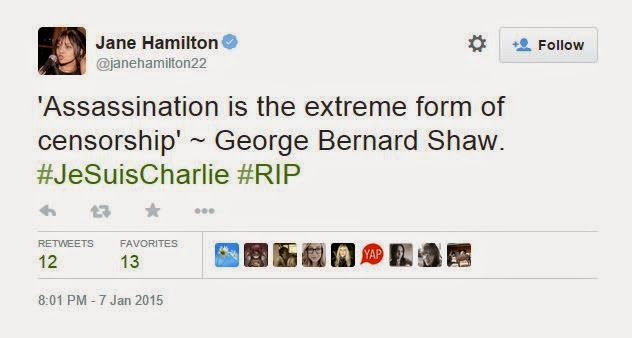
ASSASSINATION IS THE EXTREME FORM OF CENSORSHIP

After the recent terrorist attack against the French magazine Charlie Hebdo, many people have shown their support for the victims and the freedom of speech they stood for on Twitter. The hashtag chosen for the occasion is #JeSuisCharlie. Many of the messages of condolence and support have included famous quotations in defense of free speech, and against censorship and violence. Among these, you guessed it, Shaw is a favourite choice with words like these: 


I would like to offer readers a chance to source this quotation when they use it in social media. In July 1909, a Joint-Select Committee held several hearings to discuss the issue of the censorship of plays in Britain. Bernard Shaw prepared a written memorandum to be read before the Committee - published privately under the title The Statement of the Evidence in Chief of George Bernard Shaw before the Joint-Committee on Stage Plays (Censorship and Theatre Licensing).  Although Shaw was not allowed to read this text at the hearing, nor was the memorandum included in the evidence presented before the Committee, the text survived and it has been recently digitized by the Internet Archive

The relevant section of the memorandum here begins on page 15 under the heading "The Limits to Toleration." In it, Shaw argues that there must be certain limits to what we tolerate in the name of liberty. For example, 

"though we tolerate, and rightly tolerate, the propaganda of Anarchism as a political theory which embraces all that is valuable in the doctrine of Laisser-Faire and the method of Free Trade as well as all that is shocking in the views of Bakounine, we clearly cannot, or at all events will not, tolerate assassination of rulers on the ground that it is "propaganda by deed'' or sociological experiment."

Then, Shaw goes on to dismantle - in a classic example of reductio ad absurdum - some of the arguments in favor of censorship. For, if "assassination is the extreme form of censorship," a play "inciting to such an assassination" must be banned. Therefore, Julius Caesar, a play that "unquestionably vindicates and ennobles a conspirator" should not be licensed. 

And now, the grand finale (original spelling): 

"The very people who would have scouted the notion of prohibiting the performances of Julius Caesar at His Majesty's Theatre in London last year, might now entertain very seriously a proposal to exclude Indians from them, and to suppress the play completely in Calcutta and Dublin; for if the assassin of Caesar was a hero, why not the assassins of Lord Frederick Cavendish, Presidents Lincoln and McKinley, and Sir Curzon Wyllie? Here is a strong case for some constitutional means of preventing the performance of a play. True, it is an equally strong case for preventing the circulation of the Bible, which was always in the hands of our regicides; but as the Roman Catholic Church does not hesitate to accept that consequence of the censorial principle, it does not invalidate the argument."

It seems to me that if people read Shaw more, there would be fewer individuals willing to kill for religious ideals. 

Libertatea presei, Nikipercea, 1859

As an addendum to this post, it was brought to my attention - thanks to a generous reminder by Bernard Dukore, perhaps the greatest authority on Shaw quotations - that this memorandum on censorship was later used by Shaw to write the preface to The Shewing-Up of Blanco Posnet. The quotation is also found there.