Showing posts with label The Drama Observed. Show all posts

Wednesday, December 21, 2016

CHRISTMAS IS FORCED UPON A RELUCTANT AND DISGUSTED NATION BY THE SHOPKEEPERS AND THE PRESS

Caricature of George Bernard Shaw

Yes, my dear fellow Shavians. It's that time of the year again. The time of the year that, as Shaw put it,

"Christmas is forced upon a reluctant and disgusted nation by the shopkeepers and the press; on its own merits it would wither and shrivel in the fiery breath of universal hatred."


But this blog is solely concerned with sourcing quotations, and that's what we're going to do. The bad-tempered remark above is to be found in an article published in the Saturday Review (1 January 1898), entitled "Peace and Goodwill to Managers." The article is included in Vol. III of The Drama Observed, 1897-1911, as well as in Shaw's Dramatic Criticism from the Saturday Review, 1895-1898 and Dramatic Opinions and Essays (Vol. II), this one available online.  

The "rant" against Christmas that opens the article is, in fact, a little longer than the quotation above. It reads: 

"I am sorry to have to introduce the subject of Christmas in these articles. It is an indecent subject; a cruel, gluttonous subject; a drunken, disorderly subject; a wasteful, disastrous subject; a wicked, cadging, lying, filthy, blasphemous, and demoralizing subject. Christmas is forced on a reluctant and disgusted nation by the shopkeepers and the press: on its own merits it would wither and shrivel in the fiery breath of universal hatred; and anyone who looked back to it would be turned into a pillar of greasy sausages."

This quotation has been used by some authors to illustrate Shaw's well-known dislike for Christmas and the celebrations it conventionally involves. For example, Hesketh Pearson quotes this passage in two of his biographical volumes: G.B.S.: A Full Length Portrait (p. 146) and Bernard Shaw: A Biography (p. 176). 

George Bernard Shaw, his life and works; a critical biography (authorized) (1911) (14595271509)

This, of course, is not the only passage by Shaw where one gets an idea of how much he truly "hated" Christmas. Some are even harsher, like the fragment from one of his pieces of music criticism (Music in London, 1890-94 Vol. III, p. 113. 20 December 1893):

"Like all intelligent people, I greatly dislike Christmas. It revolts me to see a whole nation refrain from music for weeks together in order that every man may rifle his neighbour's pockets under cover of a ghastly general pretence of festivity. It is really an atrocious institution, this Christmas. 
We must be gluttonous because it is Christmas. We must be drunken because it is Christmas. We must be insincerely generous; we must buy things that nobody wants, and give them to people we don't like; we must go to absurd entertainments, that make even our little children satirical; we must writhe under venal officiousness from legions of freebooters, all because it is Christmas - that is, because the mass of the population, including the all powerful middle class tradesmen, depend on a week of licence and brigandage, waste and intemperance to clear off its outstanding liabilities at the end of the year. As for me, I shall fly from it all tomorrow or next day to some remote spot miles from a shop, where nothing worse can befall me than a serenade from a few peasants, or some equally harmless survival of medieval mummery, shyly proffered, not advertised, moderate in its expectations, and soon over. In town there is, for the moment, nothing for me or any honest man to do."

But all Shaw quotations are not quite complete without their share of anti-climax. However, since the author does not supply the anti-climax this time, I guess circumstances will. That is the only explanation I find for The Bernard Shaw Christmas Flea Market, of course. 

Sunday, September 25, 2016

TWO COUNTRIES SEPARATED BY A COMMON? LANGUAGE

A couple of days ago a dear friend asked me if the oft-quoted line "the British and Americans are two peoples separated by a common language..." was actually something Shaw had coined. This quip, and slightly altered versions thereof, has been attributed to Shaw - often by illustrious people who actually met him. For example, The Shavian 6.5 (Spring 1987) includes a brief note that reads as follows: 


However, as the excellent, informative post by The Quote Investigator demonstrates, chances are Shaw never uttered those words; or, at least, as my own database seems to suggest, there is no reliable, extant record of the when and where. 

Given the futility of my sleuthing, I thought it would be a good idea to go over a few passages where Shaw refers to or comments on the English spoken in America - mind you, a rather different version of the language than the one we hear today; and far from being a single, unified variety for that matter.

Differences in semantics and usage between American and British English, for example, could have arguably confused visitors of the 1902 photographic exhibitions of the Linked Ring and the Royal Photographic Society. Shaw did not have a high opinion of one of Edward Steichen's works, but...

"To make matters worse, Mr. Steichen actually labels the lady with the cat in the American language. He calls her a "nude." This may be American modesty; but in English the adjective is only used substantively by old-fashioned dealers to denote a naughty French picture. This use of the word is also exemplified on the books entitled Nudes from the Paris Salon. Consequently English artists use the term Life Study, which is more accurate descriptively, and better grammar to boot." (Bernard Shaw on Photography, p. 88)

A working knowledge, then, of the differences between these two varieties of English is a good thing. Shaw seems to corroborate this notion in his review of Olivia (by W. G. Wills), published in the Saturday Review on 6 Feb. 1897. 

"Its success, if it does succeed, will be due mainly to the acting of Miss Cicely Richards, who pulls it through with great ability, seconded effectively by Mr Cockburn. Miss Esme Beringer's impersonation of the heroine, though altogether artificial, is clever; and Mr Courtenay Thorpe manages to play with some distinction as the father. Mr Abingdon is a comic American interviewer; but the part is beneath criticism. Besides, Mr Abingdon has no command of the American language." (The Drama Observed. Vol. II, p. 771).

This is not the only critical piece by Shaw where we find a reference to "the American language" as a simple way to sketch the idiolect of a performer, somewhat derisively. In Music in London (Vol. II, p. 236), a similar descriptive use of the phrase is made 


An American accent, in addition, does not guarantee a comfortable living - although the opposite is also true. See, for example, the following extract from one of Shaw's letters to Charlotte (31st Oct. 1897): 

"There is a young American musician-a Philadelphian genius-the only American I ever met without an American accent-at present starving in Paris in the usual way. His name is Philip Dalmas..." (Collected Letters, 1874-1897, p. 818)

It is also true, nevertheless, that one can never be too sure about Shaw's real opinion on this question. Let us be reminded of the anecdote included in Allan Chappelow's Shaw the Villager and Human Being - A Biographical Symposium (pp. 217-218)

"Another time I criticised a radio performance of Saint Joan in which the part of St. Joan had been played by an actress with a pronounced American accent. Shaw just roared with laughter, but later told me he had telephoned the B.B.C. about it and told them he did not hear the broadcast himself, but had been told that the actress was wonderful ! That was typical of G.B.S.-you never really knew how he was going to react."

After all, Homer also nods and Shaw - who was chewed out by a listener because of his "slovenly pronunciation" during a broadcast talk - entertained certain American idiosyncrasies in pronunciation. The following fragment, for example, can be read in L.W. Connoly's Bernard Shaw and the BBC (an adapted version was published in "Shaw and BBC English" in The Independent Shavian 42.3 (2004): 


This does not mean that Shaw did not know his American English - quite the contrary. However, some critics beg to differ - however misinformed their claim is. As David Matual points out in his "Shaw's The Shewing-Up of Blanco Posnet and Tolstoy's The Power of Darkness: Dramatic Kinship and Theological Opposition" (SHAW 1, p. 129), critics like H.L. Mencken "ridicule Shaw's inept reproduction of what he imagined to be American English."

At any rate, I believe what best summarizes Shaw's views on the power of language and what it means in a holistic sense (social, economic, literary, ritualistic) is his response to an adaptation of Hamlet in "contemporary American English" by Irvin Fiske: 

There's the rub!


Monday, April 18, 2016

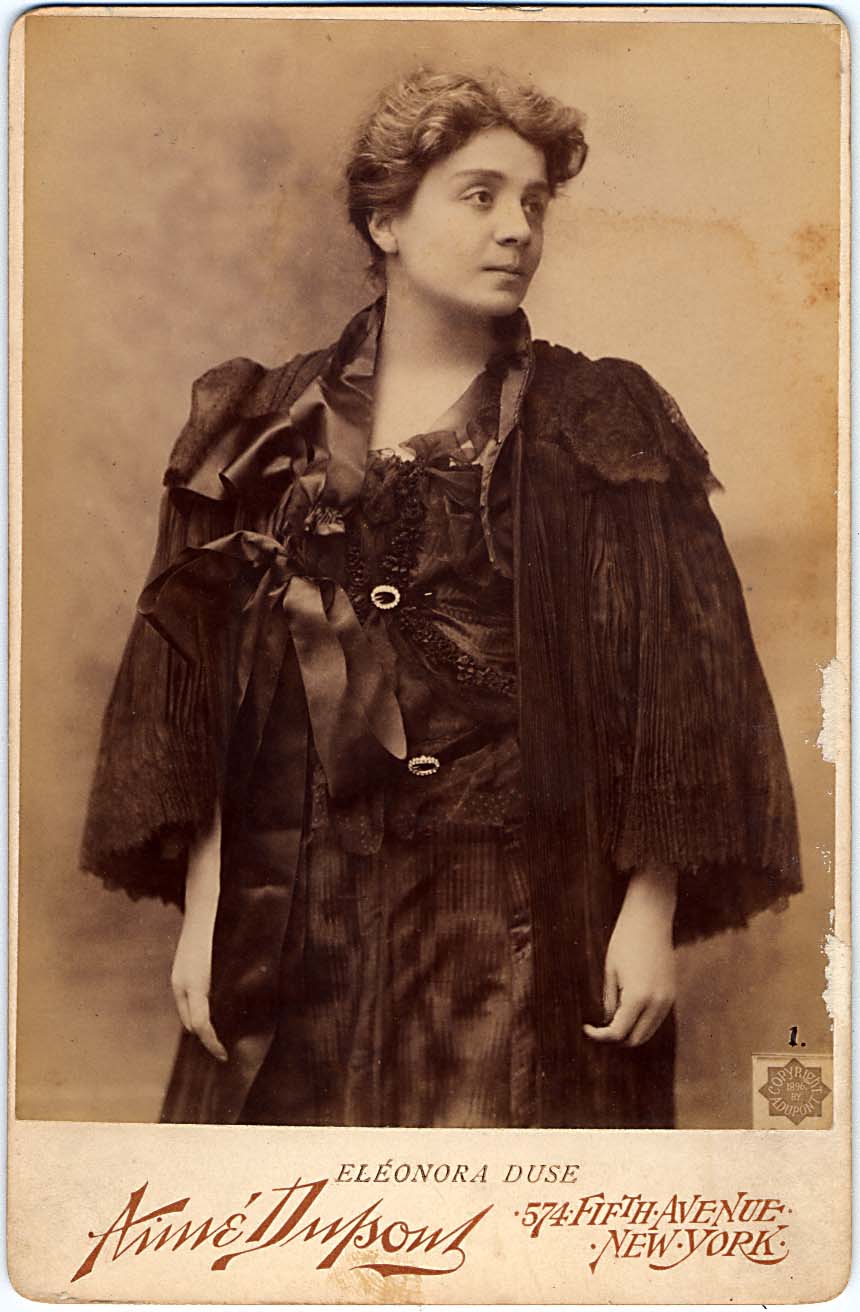
THE DIFFERENCE BETWEEN AN EFFECTIVE PART AND A WELL PLAYED ONE; OR, DUSE AND BERNHARDT.

It wasn't long ago that I found a brief online biography of Italian actress Eleonora Duse. The biography made reference to how Shaw "gave his nod to Duse" in her unspoken rivalry of years with Sarah Bernhardt. Shaw praised Duse, we read, "in an adamant oratory quoted by biographer Frances Winwar." 


I was, of course, curious about the exact words of that "adamant oratory" and I immediately turned to Winwar's biography in search of the words by Shaw. Winwar, in his Wingless Victory - A Biography of Gabriele D'Annunzio and Eleonora Duse, indeed refers to the occasion when both actresses "decided to play Magda, Duse at the Drury Lane and Bernhardt at Daly's Theater" in what the author calls a "duel for supremacy." He goes on to describe how Shaw "voted unqualifiedly for Duse and defended his choice with trenchant oratory." No source, alas, is provided for this episode. 

A similar account is provided in Taranow's biography of Bernhardt, where he refers to Shaw as a "passionate Ibsenite" who "was negatively sensitive" to Bernhardt's performances. 

A much later biography of Duse (by Helen Sheehy) includes a reference to the same critical piece by Shaw and his opinions on Duse's performance. This time, we are only a little luckier in reading that it was written soon after Shaw had begun writing for The Saturday Review

Once this information is provided, it is easy to turn to any of the excellent edited collections of Shaw's dramatic criticism in order to find the relevant article. Specifically, "Duse and Bernhardt" (that was its title) was published on June 15, 1895. The full text of the article is available HERE. UNZ.org has also digitized this text and made it publicly available HERE. Other collections where the article can be read include Bernard F. Dukore's The Drama Observed (Vol. II, pp. 366-371)

Since I know you are more than capable of reading the article yourself and drawing your own conclusions, I will only bring to your attention how this article has been quoted and used in other media as an example of superb dramatic criticism and as the epitome of a certain kind of approach to acting. An approach that, as Shaw's article suggests, can tell "the difference between an effective part and a well-played one."

After the 2006 Academy Awards, for example, Shaw's less-than-Solomonic judgement on these two actresses was borrowed to illustrate how "beauty in acting has less to do with good genes (or a great plastic surgeon) than with the representation of human truth."

The rivalry between both icons of acting (together with the observations by Shaw) was dramatized in 2003, in a "frightening" face-off

"Duse and Bernhardt" was also included as an external element in a more recent adaptation of this historical competition, "The Ladies of the Camellias"

In fact, Shaw's "un-Shavian rapture" is the basis of Sheehy's biography of Duse, as suggested by this New York Times review.

In a more distant, convolute connection, Shaw is quoted in a review of a ballet coreography based on Duse's professional life (in German).  


Well, I hope this gives you an idea of how relevant a drama critic Bernard Shaw still is. I'm sure you all have your favorite in the Duse-Bernhardt duel, but nothing compares to Shaw's critical essays. 

Monday, November 23, 2015

ANOTHER FOREIGN LANGUAGE - THAT OF AMURRICA

During the wonderful Shaw in NYC Conferece that was so successfully organized, and thoroughly enjoyed by many of us last October, my friend Jean Reynolds gave me a few Shaw books she had extra copies of so that I could enlarge my personal library. This is something she has been doing for a while now, and I cannot thank her enough for it. I normally try to return the favour by sending her a digitized copy of whatever books she gives me - a deal any of you can get, by the way. 

This time, one of the books I got is a relatively well-preserved copy of The Quintessence of G.B.S., edited by Stephen Winsten (1949)


This book is a lode of invaluable information for quotation hunters like me, as it is basically a compendium of Shaw quotations with their corresponding source. As luck would have it, I turned one of the pages and I found an old scrap of paper that had been probably used as a page marker for a long time. 


When I took it out of the book in order to scan that particular page, my eye was caught by what seemed a rather unusual choice of words for Shaw:

Another foreign language - that of Amurrica. 

Winsten tells us that this phrase is taken from Our Theatres in the Nineties, one of the collections of Shaw's dramatic criticism. Although I was ready to take Winsten's word for it, I wanted to see the quotation in its larger context, so I decided to locate it. The problem was that the editor had forgotten to say in which of the three volumes of Our Theatres in the Nineties this exact quotation is to be found. As many of you know, this collection of critical essays consists of three volumes containing the articles Shaw contributed weekly to The Saturday Review from January 1895 to May 1898 - in other words, a little over 150 articles, or more than 800 pages of text.  

A quick search in my database (technology really is something!) returns the exact occurrence of the above quotation on page 163 of Volume I, in an article that critiqued one of Augustin Daly's productions. The article in question was entitled "Mr Daly Fossilizes" (29 June 1895), and was written on occasion of the staging  of The Railroad of Love at Daly's Theatre, a comedy in four acts adapted by Mr. Daly from a German play called Goldfische, by Franz von Schönthan and Gustav Kadelburg. 

The excerpt on the alleged foreign language of "Amurrica" is the opening sentence of the article, and it introduces Shaw's argument that Daly's adaptation was already completely outmoded and superseded in London's West End at this point. In Shaw's own words: 

"I wonder how far Mr Daly realizes how completely that state of things has gone by. When Mr Charrington produced Ibsen's Doll's House at the Royalty in 1889, he smashed up the British drama of the eighties. Not that the public liked Ibsen: he was infinitely too good for that. But the practical business point is not how people liked Ibsen, but how they liked Byron, Sardou, and Tom Taylor after lbsen. And that is the point that our managers miss."

By the way, those of you who may not have a copy of Our Theatres in the Nineties handy can also read this article in The Drama Observed (Vol. II, pp. 378-383), edited by Bernard F. Dukore

Once the point in question has been sufficiently clarified, there are at least a couple of things worth commenting on. The first one is that, to be frank, given Shaw's interest in music, phonetics, and speech, I was expecting this quotation to be related to American accents on stage or someting of that nature. 

Also, it gives one a different perspective on what we consider contemporary jargon. The Internet is plagued with pseudo-comic memes satirizing - commonly through exaggeration - any aspect of the American stereotype. These usually label the resulting portrait "Murica."


Well, contrary to what I initially believed, but very much in line with what Shaw represents, he was ahead of his time in this also.