Showing posts with label The Shavian. Show all posts

Wednesday, April 22, 2015

THE SHAVIAN (1946 - 2014): SCHOLARSHIP, HISTORY, AND PEOPLE (EXHIBITION).

A few months ago I offered my readers a sneak peek of a digitation project that included an almost complete collection of past issues of The Shavian, generously donated by Evelyn EllisAfter all the journals (and attached ephemera) were digitized, a sample of the most interesting issues in the set was displayed in an exhibition entitled: The Shavian (1946-2014): Scholarship, History, and People

Here's the promotional poster: 


The exhibition was set up in the main hall of the Faculty of Letters (University of Extremadura, Spain)I just wanted to share a few pictures I took the first day, right after the display cabinets had just been arranged. I hope you enjoy them. 

Thursday, February 19, 2015

A MAN NEVER TELLS YOU ANYTHING UNTIL YOU CONTRADICT HIM

This is probably one of the most popular quotations in Shaw's repertoire. Indeed, photographs like this one abound on the Internet. 


The quotation originated in a letter Shaw sent to Ellen Terry (28 Aug. 1896), included in Bernard Shaw Collected Letters Vol. I (1874-1897), p. 645.

"But I dread success. To have succeeded is to have finished one’s business on earth, like the male spider, who is killed by the female the moment he has succeeded in his courtship. I like a state of continual becoming, with a goal in front and not behind. Then, too, I like fighting successful people; attacking them; rousing them; trying their mettle; kicking down their sand castles so as to make them build stone ones, and so on. It develops one’s muscles. Besides, one learns from it: a man never tells you anything until you contradict him."


From the point of view of "contradiction" as a powerful tool to mine out the truth from people, Shaw followed what he preached. In another letter to Ellen Terry (25 Nov. 1905), he probed her thoughts on whether she considered Frederick Kerr to be the best option to play Brassbound in these terms: 

"Unless you contradict me, I shall assume that you prefer him to the available alternatives."

Of course, this tecnique - although effective - was not without detractors. As we can read in an article by Tom Miller (The Shavian 8.8, 2000), professor Harold J. Laski did not enjoy Shaw as a provocateur who fostered conflicting arguments, especially because Shaw seemed to have the sympathetic upper hand from his audience: 

"He talks as though he knows that Europe is listening at the keyhole to what he says; and he has, consequently, a reckless disregard for truth where this is in conflict with sensation that I really find a painful thing. And the adulation which surrounds him is irritating beyond words. He says something which makes you revolt; you contradict; and his audience looks at you as though you had spat upon the Eucharist." (8 Jan. 1928)

This is not to imply that Shaw would not "contradict himself" from time to time, as we all know. To quote but one - should I say momentous - example, Beatrice Webb records in his typescript diary (24 May 1927) that while she was "reading proofs of The Intelligent Woman's Guide to Socialism and Capitalism" together with her husband, she pointed out to Shaw that he had "contradicted himself more than once in the book." In Beatrice's recollection of the event, Shaw was "rather impressed especially as I insisted that I did not want him to alter anything he had written."

I wonder if self-contradiction was Shaw's way of getting the truth out of himself?

By the way, Beatrice Webb's both manuscript and typescript diaries are digitized and freely available at the LSE Digital Library. A phenomenal initiative and an endless lode of information for research. 

Beatrice Webb, c1875

Thursday, September 18, 2014

DIGITIZING SHAW - THE SHAW QUOTATION DATABASE

My countless followers and readers - "countless" meaning that I don't usually count them - are surely wondering why the blog has been kind of slow as of late. The answer is simple: I'm digitizing stuff. 

I would like to explain how my database came into being by utilizing the materials I'm currently digitizing as an example. In this case, I got a large parcel in the mail that contained an almost complete collection of The Shavian (in its various formats and denominations) ranging from the first-ever 1946 issue to the latest issue (2014). 


The parcel had been kindly sent by Evelyn Ellis, who took the trouble to put every issue into individual envelopes and include a complete index of what was included. Once open, the complete collection looked like this: 


So, as I usally do in what's left of my lunch break and other lapses of downtime, I lock myself in the photocopying room, where the new scanner of the English Philology Department at the Universidad de Extremadura awaits. 


If you look closely at the above picture, you'll see a black memory drive sticking out on the side of the machine. That's where everything I digitize goes, so that I can later edit the documents with the aid of this OCR software

Given that the Shavians are bound documents, I have to scan them one page at a time, with the additional handicap that they do not fit the standard A4 paper size. Therefore, I have to make use of state-of-the-art technology (a ruler!) and type in the width and length of the issue in question (expressed in millimeters). 


Although you can save any given measurements for later use, you may be surprised to know that not all Shavians are alike (pun intended!) For example, whereas most of them are 280x215 mm; number 7, however, is 250x185mm - to mention but one of the several cases in which I had to input a different scanning size. Once you know the area of the spread pages of a given issue, you just have to type in the numbers - always bearing in mind the orientation; i.e. what the x and y axis are. 


After all this, the process becomes quite straightforward: you just have to scan each page in succession, trying to silence the symptoms of the carpal tunnel syndrome you're slowly developing

Still, there are a few things that slow down the whole routine. For example, many of the issues are missing the staples that bind them, which means that you have to be extra careful not to let the page slant out of the scanning area. 


On occasion, the staples leave ugly rust marks in the middle of the page. Luckily, they do not usually impede the digitation and can be later erased or ignored when the document is edited. 


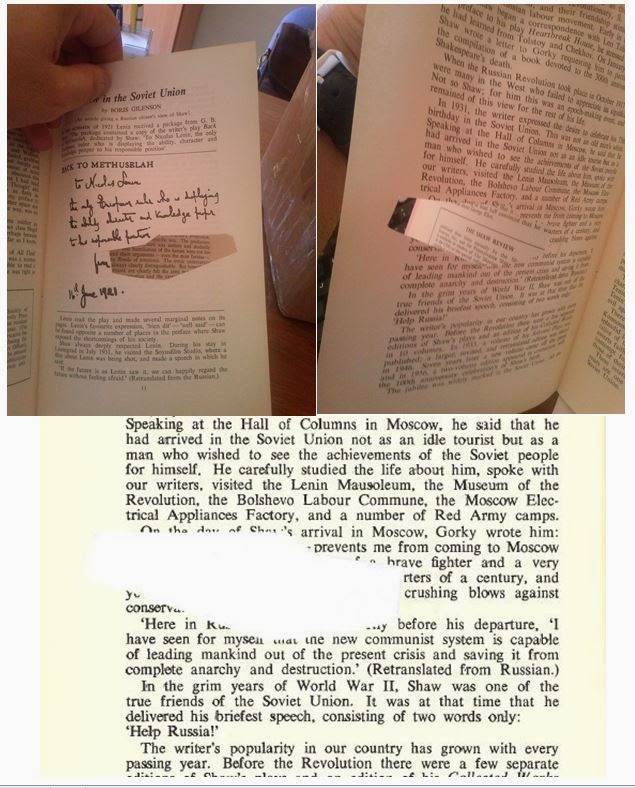
There are even some issues with holes cut out in them. In these cases, I've had to put a blank piece of paper behind the page, so that I would not scan what's on the following page through the hole. In the next three images, for example, someone had cut out Bernard Shaw's signature from the reproduction of a manuscript dedicatory. The hole, of course, spoiled the running text on the next page and the resulting scanned page, as you can see. 


Despite all these difficulties, there were some unexpected findings that really spiced up this project. Several issues had different kinds of addenda (donation slips, book advertisements, minutes and reports of the UK Shaw Society) that may become invaluable material if someone ever writes a not-so-short history of the Shaw Societies of this world. A few of these are reproduced in a presentation below. 


Well, I hope you liked what I had to share about one of my current projects. At least now you know why I'm not picking up the phone lately.